A pastry technical sheet is more than a tidy recipe. It is the tool that standardizes your preparations, calculates your real food cost and protects your margins. Without one, you price by guesswork. Here is a free Excel template, ready to fill in, and more importantly: how far it takes you before it hits its limits.
Download and fill in the template
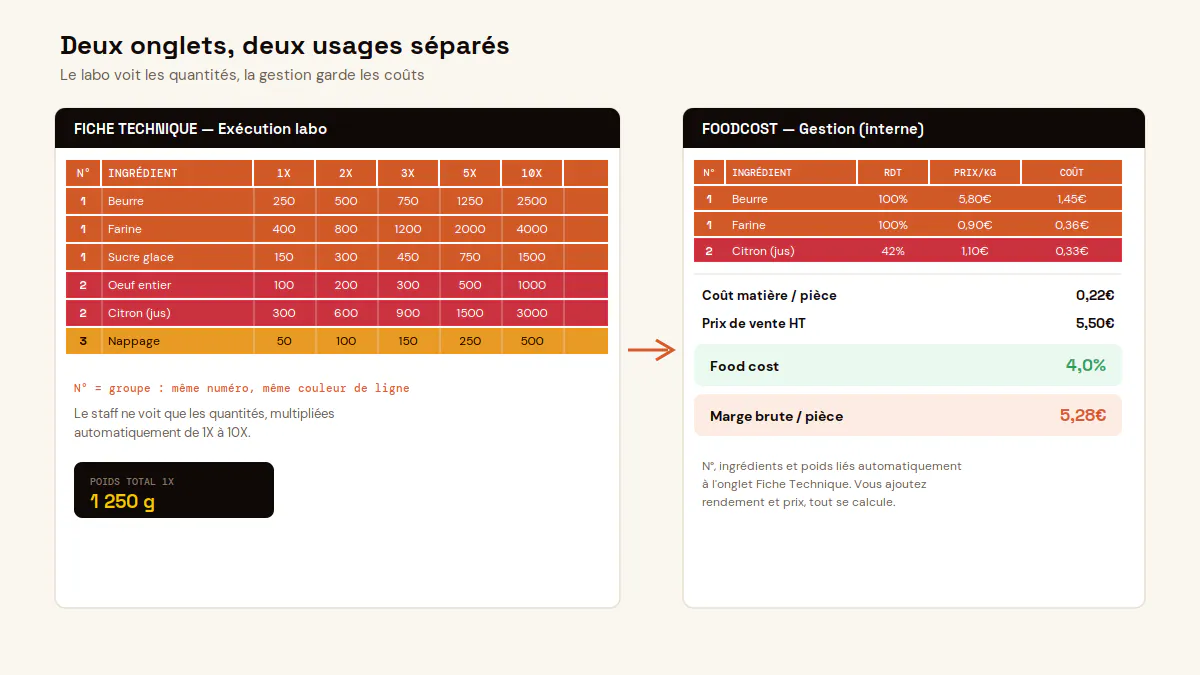
The template has two separate tabs. The Technical sheet tab is for production: recipe name, ingredient list, quantities for one piece, then multiples calculated automatically (2X, 3X, 5X, 10X) and a method column. Your team sees only the quantities, never the prices.
The Food cost tab is for management. It pulls in the ingredients from the sheet automatically, adds the net yield (the share actually usable after peeling, juicing, trimming), the price per kilo, and calculates the food cost per piece, the food cost percentage, the margin and the coefficient. You enter, the file calculates.
Group your steps with color-coded numbers
The No. column groups ingredients by step or by preparation: the crunchy layer, the ganache, the sponge. Each number triggers a color across the whole row. The result: at a glance, your team spots the recipe blocks without reading every label. It is standard conditional formatting, and it works in Excel as well as in Google Sheets.
Spot the moment the file breaks
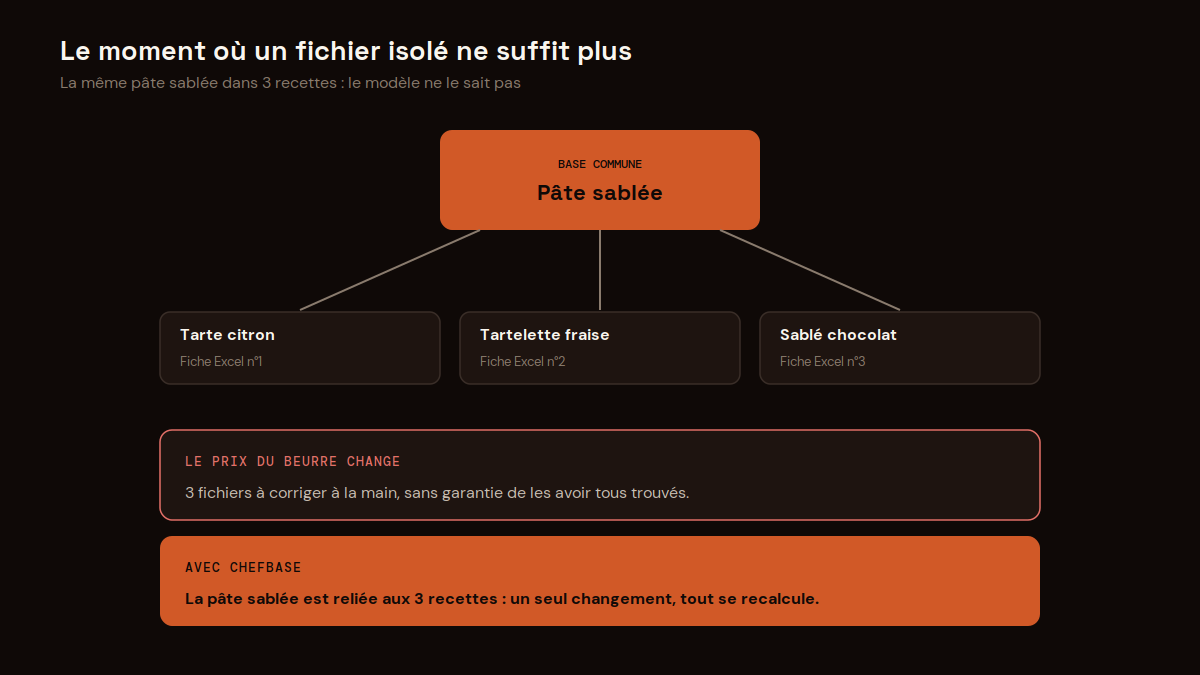
Take a sweet shortcrust pastry. You use it in your lemon tart, your chocolate tart and your fruit tartlets. With this template, you re-enter it in three separate sheets. The day butter prices rise, you have to correct the cost in all three files, by hand, without missing one. That is where the spreadsheet shows its limit: it handles an isolated recipe, not a preparation shared across several recipes.
Know when an isolated file is no longer enough
As long as you manage a few independent recipes, the spreadsheet holds. As soon as you have shared bases (a cream, a praline, a streusel reused everywhere) and your prices move, the isolated file wastes time and introduces errors. Every re-entered price is a chance to make a mistake. That is the threshold where a shared preparation must live in a single place, linked to every recipe that uses it.
This is exactly what pastry management software handles: the sub-recipe exists once, and any price change flows automatically into every finished recipe. You correct the butter once, ChefBase recalculates everywhere.
Measure the true cost of a sheet that drifts
A technical sheet that is no longer up to date costs you money, quietly. You price on a food cost from six months ago, while your purchase prices have climbed 12%. Your margin melts and nothing flags it. A spreadsheet never warns you: it shows what you last entered. That is the tipping point where tracking real margin versus theoretical margin becomes decisive for your profitability.
Key takeaway: a free Excel technical sheet template fully covers your isolated recipes: quantities, multiples, food cost, margin. It shows its limits the moment the same preparation serves several recipes and your prices move. At that point, a shared base linked to all your recipes (what ChefBase does) spares you the re-entries and the margins that drift without warning.
Frequently asked questions
What is a technical sheet in pastry?
A pastry technical sheet is a document that lists a recipe’s ingredients, their quantities, the food cost and the method. It is used to standardize production, calculate the cost price and train teams. A complete sheet also includes the net yield of ingredients and the food cost percentage.
How do you make a pastry technical sheet for free?
To make a pastry technical sheet for free, use a spreadsheet like Excel or Google Sheets: list the ingredients, their weights, the price per kilo, then apply a cost formula. The free ChefBase Excel template provides these calculations ready-made (quantity multiples, net yield, food cost) with no formula errors to fix.
What should a pastry technical sheet contain?
A pastry technical sheet should contain: the recipe name, the ingredient list with quantities, the net yield of each ingredient, the food cost, the selling price, the food cost percentage and the method. Together, these let you both produce the recipe and manage its profitability.
How do you calculate the cost of a pastry recipe?
To calculate the cost of a pastry recipe, multiply each ingredient’s weight by its price per kilo, add up the results, then divide by the number of pieces produced. For an accurate cost, factor in net yield: a squeezed lemon yields only 40 to 45% juice, so you must adjust the real price of the material actually used.
Excel or software: which is better for pastry technical sheets?
Excel works for isolated recipes or when starting out: it handles the quantities, food cost and food cost percentage of a single sheet. Software like ChefBase becomes useful as soon as the same preparation (a dough, a ganache, a praline) serves several recipes: the sub-recipe exists once and any price change recalculates automatically everywhere.