A restaurant ERP treats a whipped ganache like a fixed-portion daily special. That’s where invisible margin loss begins.
Most software sold to restaurant professionals wasn’t built for pastry. It manages fixed-portion recipes, not formulations where yield shifts with every batch and baking changes the weight. Here’s what a poorly fitted tool costs you, and what pastry-built software must cover.

Understand Why Generic Restaurant Software Falls Short in Pastry
A classic restaurant ERP thinks in dishes and fixed portions. It doesn’t know that a kilo (2.2 lb) of hulled strawberries no longer weighs a kilo (2.2 lb), that a batter loses 15% of its weight during baking, or that a poorly piped ganache leaves 80 g (2.8 oz) behind in the bowl. These tools treat pastry as a minor variant of savory cooking. The result: the displayed material cost never matches the real one.
Spot the 4 Blind Spots That Quietly Cost You Margin
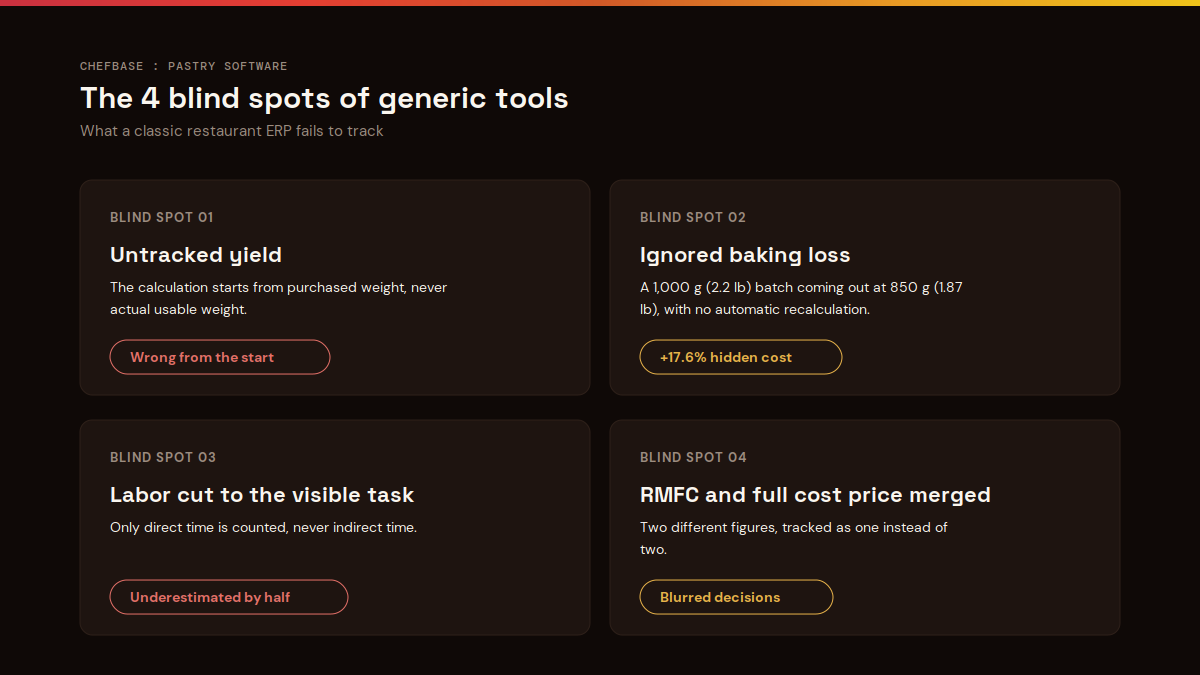
Untracked net yield: the calculation starts from purchased weight, not usable weight, wrong from the start. Ignored baking loss: a 1,000 g (2.2 lb) batch that comes out at 850 g (1.87 lb) concentrates material cost on 15% less mass, with no automatic recalculation. Labor cost cut to the visible task: timing only the direct task underestimates real cost by nearly half. Raw material food cost merged with full cost price: two different figures, treated as one.
Check Sub-Recipe Management, the Point That Changes Everything
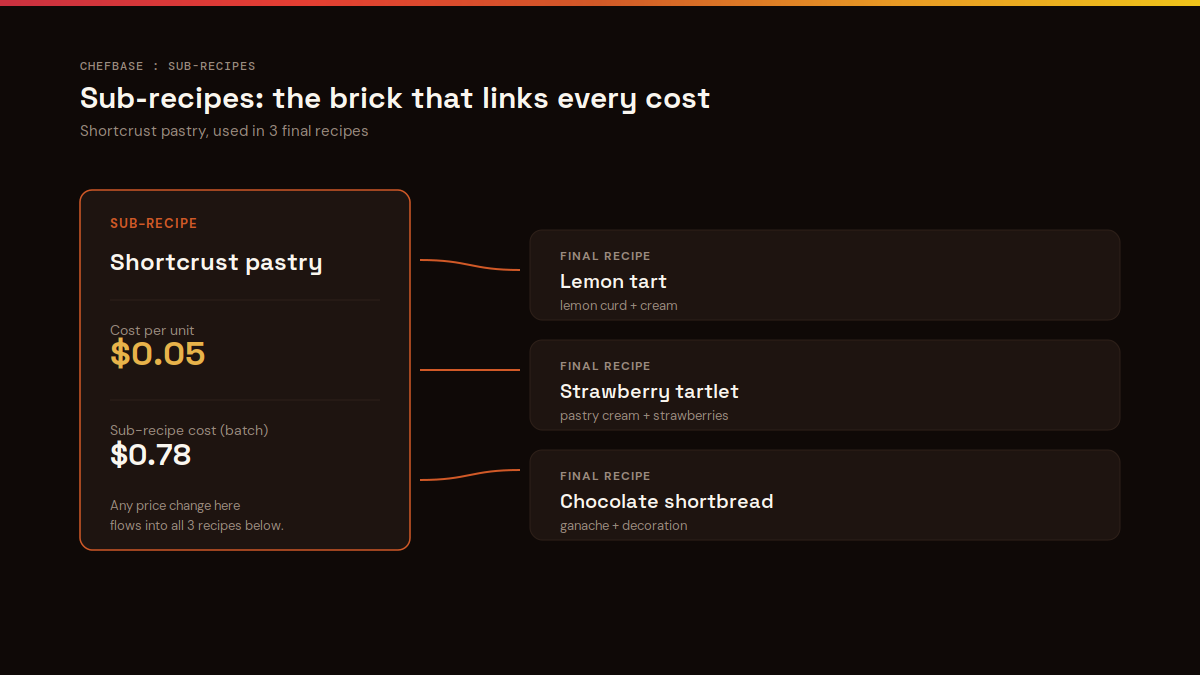
A shortcrust pastry, a cream, an insert: these sub-recipes show up in several final recipes at once. If the tool doesn’t manage them as linked building blocks, every cost (material, labor, energy) has to be re-entered recipe by recipe, and drifts as soon as a price or yield changes. A tool that handles sub-recipes correctly recalculates every affected final recipe automatically the moment a single sub-recipe changes.
Be Wary of Spreadsheets, the False Free Solution
A spreadsheet isn’t free, it costs time and reliability. No built-in traceability for shelf life or allergens. A duplicated sheet on one workstation drifts from the rest of the kitchen after the first manual edit. Material cost is never recalculated automatically when a yield or a baking step changes.
Identify What Pastry-Built Software Does That Others Don’t
A tool built for the trade calculates net yield per ingredient, separates raw material food cost from full cost price, and integrates molecular formulation (texturizers, yield coefficients). It natively handles nutrition and allergen compliance. Some go further with production forecasting or an AI copilot trained on the craft, answering technical questions directly inside the tool.
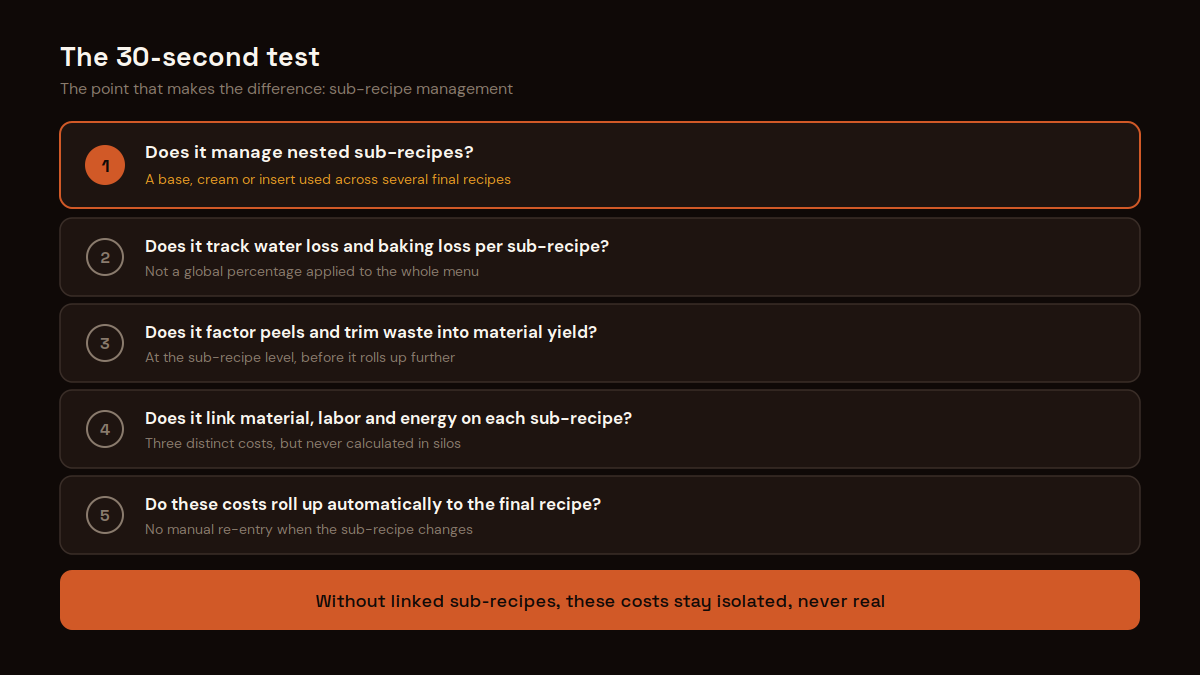
Run Any Tool Through the 30-Second Test
Five questions to ask before choosing: does it manage nested sub-recipes (a base, cream or insert used across several final recipes)? Does it track water loss and baking loss per sub-recipe, not as a global percentage? Does it factor peels and trim waste into material yield at that same level? Does it link material, labor and energy on each sub-recipe instead of calculating them in silos? Do these costs roll up automatically to the final recipe without manual re-entry? Without properly linked sub-recipes, these costs stay isolated, never real.
Measure the Real Cost of Sticking With a Poorly Fitted Tool
An untracked margin gap is money lost every week, as shown by the gap between theoretical and real margin. A correct full cost price calculation is worthless if the tool producing it isn’t built to catch these losses at the source, as covered in our pastry food cost guide.
Key takeaway
Generic restaurant software ignores variable yield, baking loss and real labor cost in pastry. The decisive point: sub-recipe management, which links material, labor and energy on every shared base and recalculates them automatically across all final recipes. Pastry-built software also separates raw material food cost from full cost price, and natively integrates nutrition and allergens. Test any tool against these five points before choosing.
The Production feature was built against exactly these five points.
Generic restaurant software wasn’t built for variable yield and sub-recipes. ChefBase was. Start free, no card required.
FAQ
Why is sub-recipe management essential in pastry software?
Sub-recipe management links a shared base (dough, cream, insert) to every final recipe that uses it, so material, labor and energy costs recalculate automatically everywhere the moment a price or yield changes, with no manual re-entry recipe by recipe.
Why doesn’t generic restaurant software work for a pastry kitchen?
Generic restaurant software manages recipes as fixed portions and ignores variable material yield, baking loss and the molecular formulation specific to pastry, which systematically skews the calculated material cost.
What’s the difference between generic and pastry-specialized software?
Pastry-specialized software calculates net yield per ingredient, separates raw material food cost from full cost price, and natively integrates nutrition and allergen compliance, unlike generic software built for traditional restaurants.
What are the limits of spreadsheets for running a pastry kitchen?
Spreadsheets don’t automatically recalculate material cost when a yield or baking step changes, provide no native shelf-life or allergen traceability, and drift as soon as one workstation edits its local copy.
How do you quickly test whether software fits pastry production?
Check whether it manages yield per batch rather than purchased weight alone, whether it separates raw material food cost from full cost price, and whether it natively tracks allergen and nutrition compliance.