You calculate a 72% margin on your entremets. At the register, you actually keep 61%. That 11-point gap shows up nowhere. It lives between your spreadsheet and your till, and it eats into your profitability every single day.
Theoretical margin is reassuring. Real margin is what decides. As long as you confuse the two, you’re running your pastry business blind.
Theoretical Margin vs Real Margin: The Difference in Pastry
Theoretical margin is what your recipe card tells you. You take the material cost, apply your selling price, and get a clean percentage. It’s a lab calculation, under perfect conditions.
Real margin is what’s left once production and sales are done. It accounts for every loss along the way: what raw material loses on its journey, what breaks, what doesn’t sell, what gets given away.
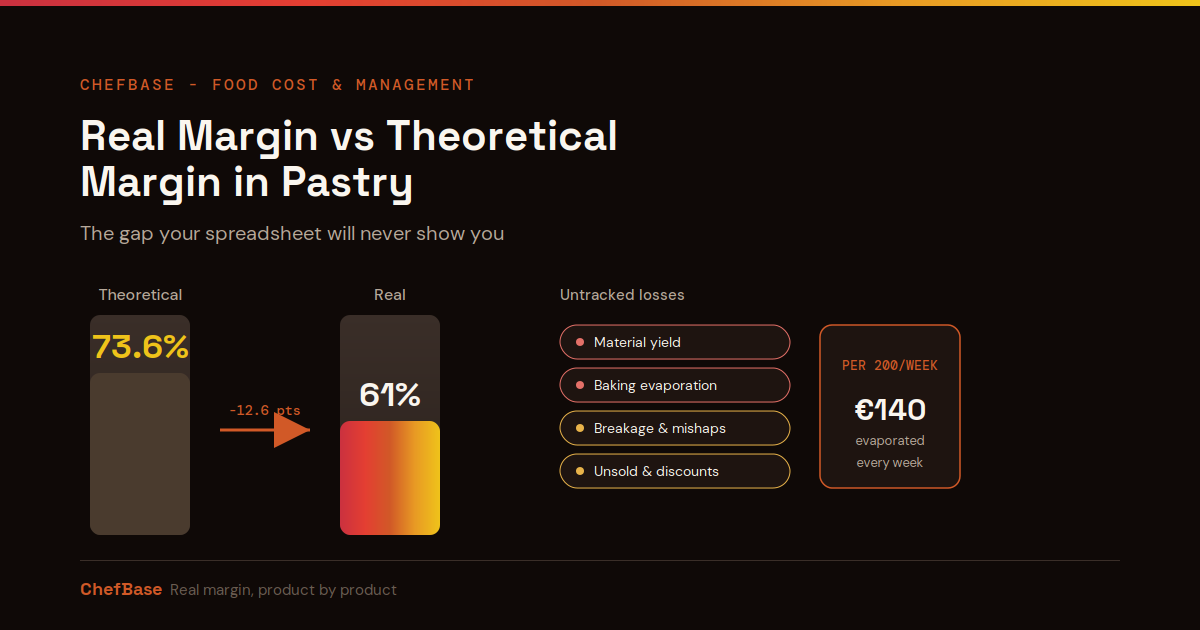
A concrete example. A lemon tart priced at $5.50 with a theoretical material cost of $1.45 shows a 73.6% margin. Add the real losses from production and sales, and your margin drops to 61%. Across 200 tarts a week, that gap represents nearly $140 evaporating. Every week. Figures here are shown in USD as a reference: adapt them to your own currency, the principle stays the same wherever you operate.
List Every Loss That Widens the Margin Gap
This is where it all plays out. A reliable real margin doesn’t come from a smarter calculation, it comes from an honest inventory of every production and sales loss. Most of them fly under the radar because they never appear on any recipe card.

Material loss during prep. A kilo (2.2 lb) of lemons doesn’t yield a kilo (2.2 lb) of juice. Peels, trims, pan residue: your real material cost is calculated on usable weight, not purchased weight. A 60% yield on a fruit changes your entire food cost.
Baking evaporation. Creams, caramels, and jams lose water in the oven. A 1,000 g (2.2 lb) batch that comes out at 850 g (1.87 lb) means the material cost is now concentrated on 15% less mass. The cost per kilo of the finished product rises mechanically, and your recipe card never sees it.
Breakage and lab mishaps. A dropped tray, a badly piped ganache leaving 80 g (2.8 oz) in the bowl, a burnt biscuit, a failed glaze. Every incident is material cost gone straight to the bin.
Unsold stock. You make 30 eclairs, you sell 26. The 4 leftover are real material cost, never offset by a sale.
Discounts and giveaways. A free coffee, 10% off for a regular, a marked-down batch at closing time. Every commercial gesture chips away at margin, product by product.
Portion drift. 42 g (1.5 oz) of ganache instead of the planned 38 g (1.3 oz). Across hundreds of units, that overdose becomes an invisible cost line.
Until these items are logged, priced, and tied to a product, your margin remains an estimate. Not a reality.
Track Every Loss to Calculate Real Margin With Precision
Knowing these losses exist isn’t enough. You need to record them, one by one, and tie each one to the right product to know exactly how much you’re losing.
This is exactly what ChefBase does. The platform lets you enter the real yield of each ingredient (the juice extracted from a kilo of lemons, the loss from peeling), the loss from evaporation during baking, breakage and lab mishaps, unsold stock, discounts and giveaways. Every loss is priced and tied to the relevant recipe card.

The material cost calculation no longer starts from purchased weight, but from weight actually used, baking and yield included. And by connecting your POS system (Square, SumUp, Toast, Lightspeed and others), the platform matches this real cost against actual recorded sales.
The result: a precisely calculated margin, product by product. You spot the bestseller that’s genuinely profitable, and the star product quietly losing you money despite its apparent success.
Correct Your Prices Based on Real Margin, Not Theoretical Margin
Once real margin is in front of you, the adjustment becomes simple and factual.
If a product shows 73% in theory but 58% in reality, you have two levers: reduce the losses (better manage yield, tighten portioning, cut down unsold stock) or reposition the price. Often, a 30 to 50 cent increase is enough to bring real margin back to target, without unsettling the customer.
The classic mistake is cutting prices to move stock, which only widens the gap. The right decision is always based on the real number, never on a gut feeling. To build on solid foundations, revisit your food cost calculation method first: a reliable real margin starts with an accurate food cost.
Monitor the Gap Between Theoretical and Real Margin Over Time
Real margin isn’t a snapshot, it’s a film. Butter prices climb, a supplier changes their rates, a yield degrades, seasonality shifts your sales. A one-off check isn’t enough.
The right habit: track the theoretical-versus-real gap by product, every week. Once a gap exceeds 10 points, there’s a loss to address. This habit transforms how you manage the business: you stop enduring your margins and start steering them.
It’s also the best protection against raw material inflation, which hits a poorly maintained recipe card before you ever notice it at the till.
Key takeaway
Theoretical margin is a recipe card calculation, real margin is what remains after every loss. Material yield, baking evaporation, breakage, lab mishaps, unsold stock, discounts, portion drift: each loss must be logged and priced to know your true margin. ChefBase tracks these losses and connects them to the till to calculate a precise, product-by-product margin. Correct your prices based on the real number, and watch the gap every week.
FAQ
What is real margin in pastry?
Real margin in pastry is the profit percentage that actually remains after a sale, once every production and commercial loss is deducted: material yield, baking evaporation, breakage, unsold stock, discounts and portion drift. It differs from theoretical margin, calculated on the recipe card alone, by an average gap of 8 to 12 points.
Why is real margin always lower than theoretical margin?
Real margin is lower than theoretical margin because the recipe card calculation ignores losses that occur after the raw material is purchased: peels and trims reduce yield, baking causes weight loss through evaporation, breakage and lab mishaps destroy material cost, and unsold stock or discounts reduce the cash actually collected.
What are the main losses that lower margin in pastry?
The six main losses are: yield loss during prep (peels, trims), water evaporation during baking that concentrates material cost, breakage and lab mishaps (badly piped ganache, burnt biscuit), end-of-day unsold stock, discounts and free items, and portion drift compared to the recipe card.
How do you calculate real margin in pastry?
To calculate real margin in pastry, start from the weight of material actually used (after yield and baking loss), add up every loss recorded per product (breakage, unsold stock, discounts), then match this real cost against sales actually collected at the till. Software like ChefBase automates this calculation by connecting recipe cards to your POS system (Square, SumUp, Toast, Lightspeed).
At what point should the gap between theoretical and real margin trigger action?
A gap greater than 10 points between theoretical and real margin signals a loss to correct: misjudged material yield, too much unsold stock, uncontrolled discounts, or imprecise portioning. A gap below 10 points remains within normal range for an artisan pastry business.
Should you lower prices when real margin is too low?
No. Lowering prices to move stock generally widens the gap between theoretical and real margin further. The recommended approach is to first reduce the identified losses (yield, breakage, unsold stock), then adjust the selling price if needed, often by just 30 to 50 cents.