You repeat a recipe you know by heart. It works, so you stop questioning it. But do you know why it holds together? Most pastry chefs spend their careers executing recipes without ever interrogating their internal logic. The result: at the first adjustment (a swapped fruit puree, a revised dosage), everything collapses. The texture-first method changes that: it makes you reason about the structure of a recipe, not just its execution.
Think in Percentages, Not Just Weights
Weight tells you how much. Percentage tells you how ingredients behave relative to each other. A recipe at 62% total liquid doesn’t behave like one at 45%, regardless of batch size. Switching to percentages (baker’s percentage) lets you scale a recipe without recalculating everything, and more importantly, lets you compare two recipes to understand why one holds and the other doesn’t.
Ask the 3 Questions of the Texture-First Method
Before touching the weights, ask yourself three questions, all equally important, for every recipe:
- Texture: what texture are you actually aiming for (whipped, set, crisp, smooth)?
- Techniques: which family of techniques produces that texture?
- Balance: do the water, fat, and structuring agent ratios hold that texture over time?
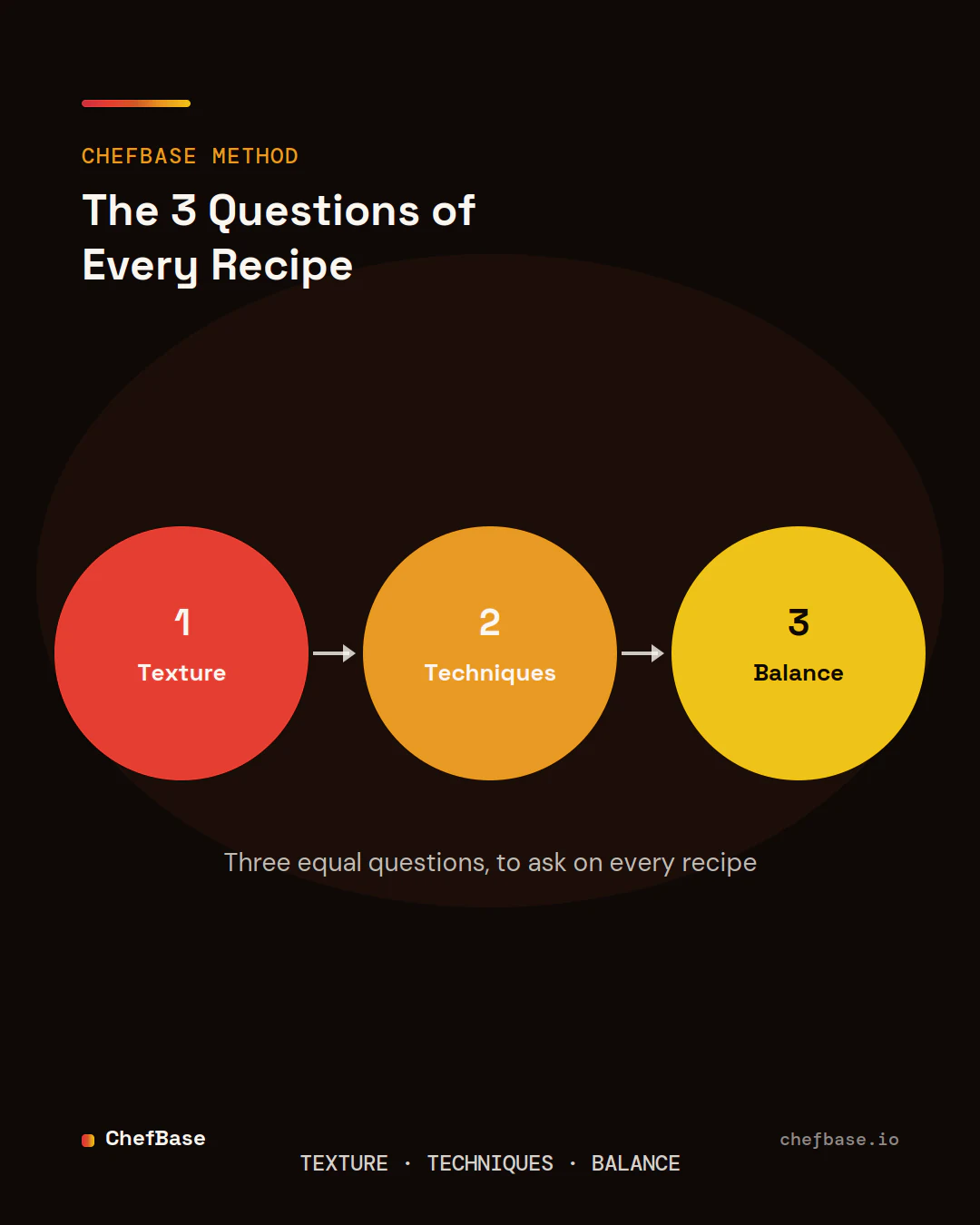
These three questions aren’t hierarchical. They inform each other: a misidentified texture leads to the wrong technique, and a good technique that’s poorly balanced won’t hold.
Identify the 5 Technique Families
Every texture in pastry relies on a combination of 5 families: emulsification (mousses, whipped creams), coagulation (baked structures, custards), gelation (gels, inserts), aeration (foam, light mousses), and thickening (glossy textures, creams). Each family follows its own physico-chemical logic. A well-built technical sheet already documents this logic, even without naming it.
Balance Sugar, Fat, and Water: Balance Means Stability
Balance isn’t about flavor, it’s about hold. Too much free water in a mousse, and it collapses within hours. Not enough gelling agent relative to the water present, and the gel never sets firm. Too much fat relative to the rest of the structure, and the mixture separates during baking. Every ingredient has a textural function, not just a flavor one: sugar binds water, fat structures or softens, water activates or dissolves structuring agents. Unbalance one, and you destabilize the other two.

Reformulate Entirely When You Swap a Fruit Puree
A common mistake: replacing one fruit puree with another while keeping the same weight. No two fruit purees share the same water content, natural sugar level, or acidity, which shifts the entire water, sugar, and gelling agent balance of the recipe. Changing a base ingredient means recalculating the full formulation, not just substituting one line. ChefBase’s Formulation module automatically recalculates these ratios the moment an ingredient changes, so you can see the impact before testing in the lab.
Key takeaway
A recipe that works isn’t necessarily a recipe you understand. Think in percentages, ask the 3 questions (texture, techniques, balance), and treat every ingredient swap as a full reformulation.
To go further on structuring your recipes, also read our article on pastry pricing and markup.
FAQ: Pastry Recipe Formulation
What is the texture-first method in pastry?
It’s a formulation approach that starts from the desired texture (whipped, set, crisp) to determine the technique and ingredient balance, rather than starting directly from an existing recipe’s weights.
Why think in percentages instead of weights?
Percentage expresses the relationship between ingredients, independent of batch size. It lets you compare two recipes, spot an imbalance, and scale production without recalculating everything.
What are the 5 base techniques in pastry formulation?
Emulsification, coagulation, gelation, aeration, and thickening. Each follows a different physico-chemical logic and produces a specific family of textures.
Why does a mousse collapse if it contains too much water?
Free water not bound by sugar or a structuring agent destabilizes the air bubbles incorporated during aeration. Without enough structure to trap them, the mousse loses its aeration and falls.
Can you swap one fruit puree for another without recalculating everything?
No. Each puree has its own water, sugar, and acidity content. Changing the fruit shifts the recipe’s overall balance and requires reformulation, not just a weight substitution.