A flat 3x markup applied across the entire menu, no distinction by product or channel: it’s the most common pricing method in pastry, and the most dangerous one. It ignores positioning, sales channel, and product type.
The pricing markup is not a fixed constant. It’s a management tool that should vary with your strategy, your end customer, and your actual food cost. Here’s how to calibrate it correctly, factor by factor.
Understand what a pricing markup actually is
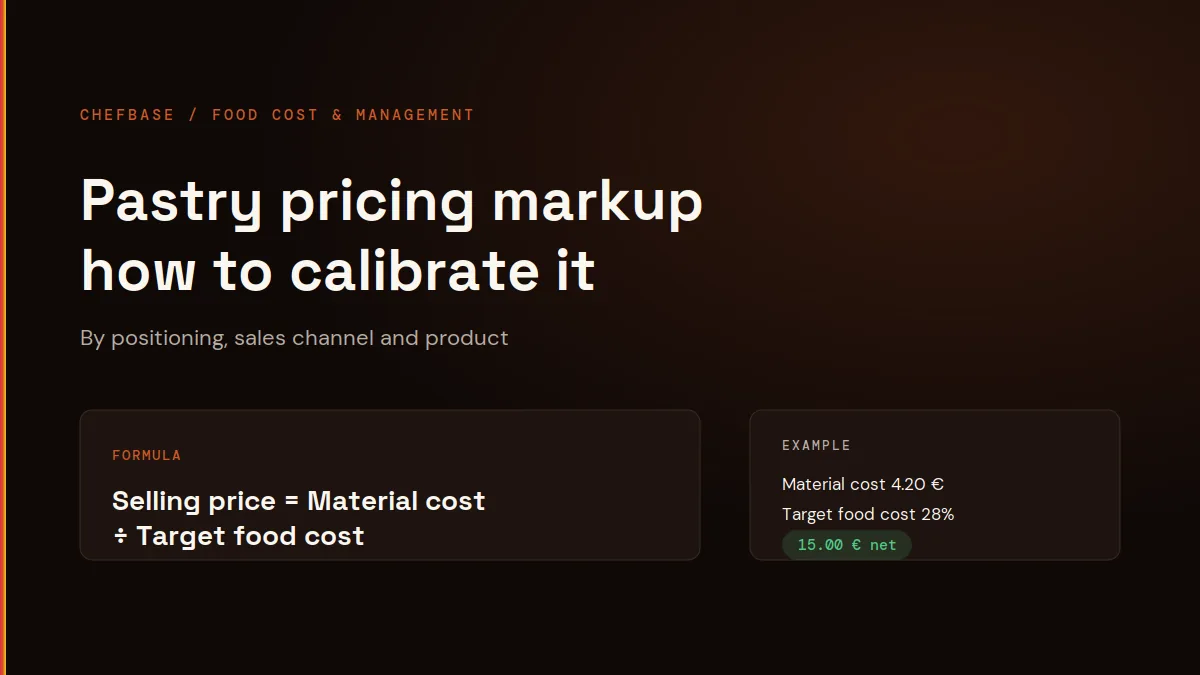
The pricing markup (or multiplier) is the factor that converts your material cost into a net selling price. Base formula: selling price = material cost × markup. A markup of 3.5 on an entremets with a 4.20 € material cost gives a selling price of 14.70 € net.
This figure only makes sense relative to a target food cost. A 3x markup targets a food cost around 33%. A 4x markup targets 25%. If your material cost is miscalculated upstream (yield, losses, sub-recipes not costed), the markup amplifies the error instead of correcting it.
Calculate your selling price from food cost
The full formula: selling price = material cost ÷ target food cost (as a %). For a lemon tart with 1.80 € material cost and a target food cost of 28%: 1.80 ÷ 0.28 = 6.43 € net.
Example for a bakery on a premium viennoiserie: material cost 0.62 €, target food cost 22% (a loss-leader product with a deliberately tight margin), selling price = 0.62 ÷ 0.22 = 2.82 € net. The same calculation applied to a signature cake with a 30% target food cost gives an effective markup close to 3.3x.
Adapt the markup to your positioning
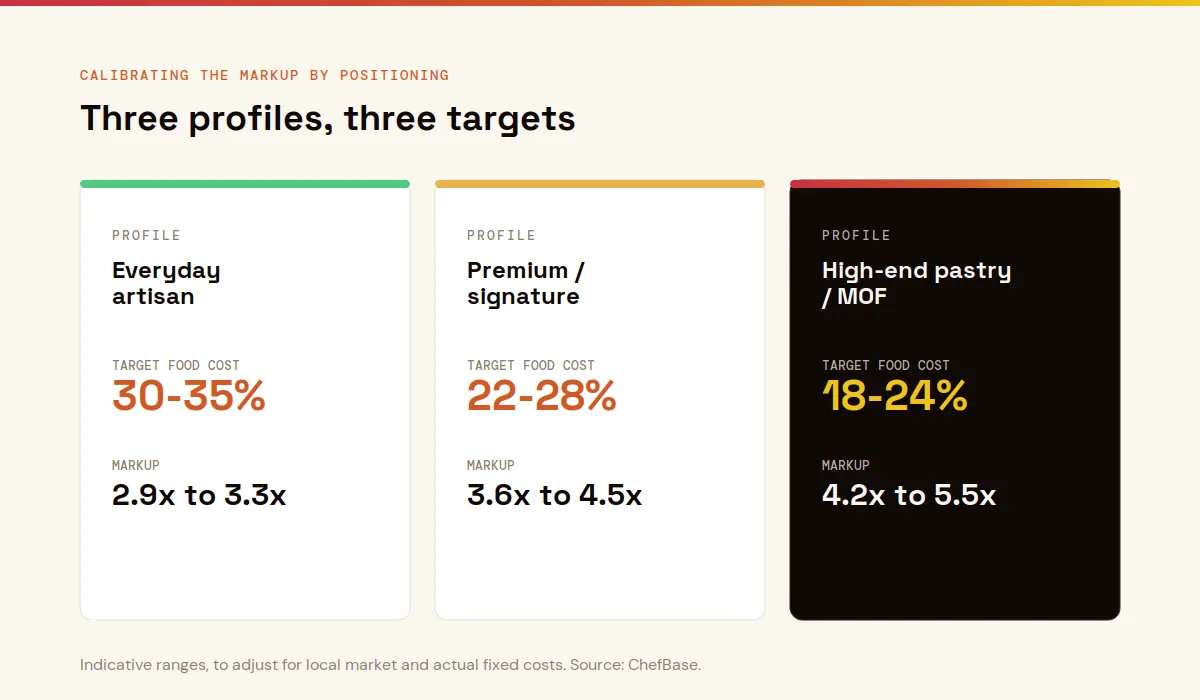
A neighborhood artisan bakery and a premium pastry house don’t target the same food cost. Positioning determines what the customer is willing to pay, and therefore the margin you can capture without losing volume.
| Positioning | Target food cost | Equivalent markup |
|---|---|---|
| Everyday artisan | 30 to 35% | 2.9x to 3.3x |
| Premium / signature | 22 to 28% | 3.6x to 4.5x |
| High-end pastry / MOF | 18 to 24% | 4.2x to 5.5x |
These ranges are not absolute rules. They serve as a starting point, to be adjusted based on your local market and your actual fixed costs.
Adapt the markup by sales channel
The same product doesn’t sell at the same markup depending on the channel. In direct retail, you capture the full margin. In hospitality or B2B resale, the intermediary customer takes their own margin, which mechanically compresses your markup if you want to stay competitive on the final price.
A lab selling both direct and B2B needs to run two separate markup grids. Applying the retail markup to a high-volume luxury hospitality order leads either to an off-market price or to a crushed B2B margin you don’t even notice.
Handle cases where the standard markup doesn’t apply
Some products are deliberately sold at low margin: daily bread, loss-leader viennoiserie, a signature item that draws customers toward the rest of the menu. The markup drops below the general target here, deliberately and by design, not by accident.
The risk is letting these exceptions multiply unidentified. Without product-by-product tracking, a lab can end up with an average declared food cost of 28% that masks swings of 18 to 40% depending on the item.
Track your real markup, not just the theoretical one
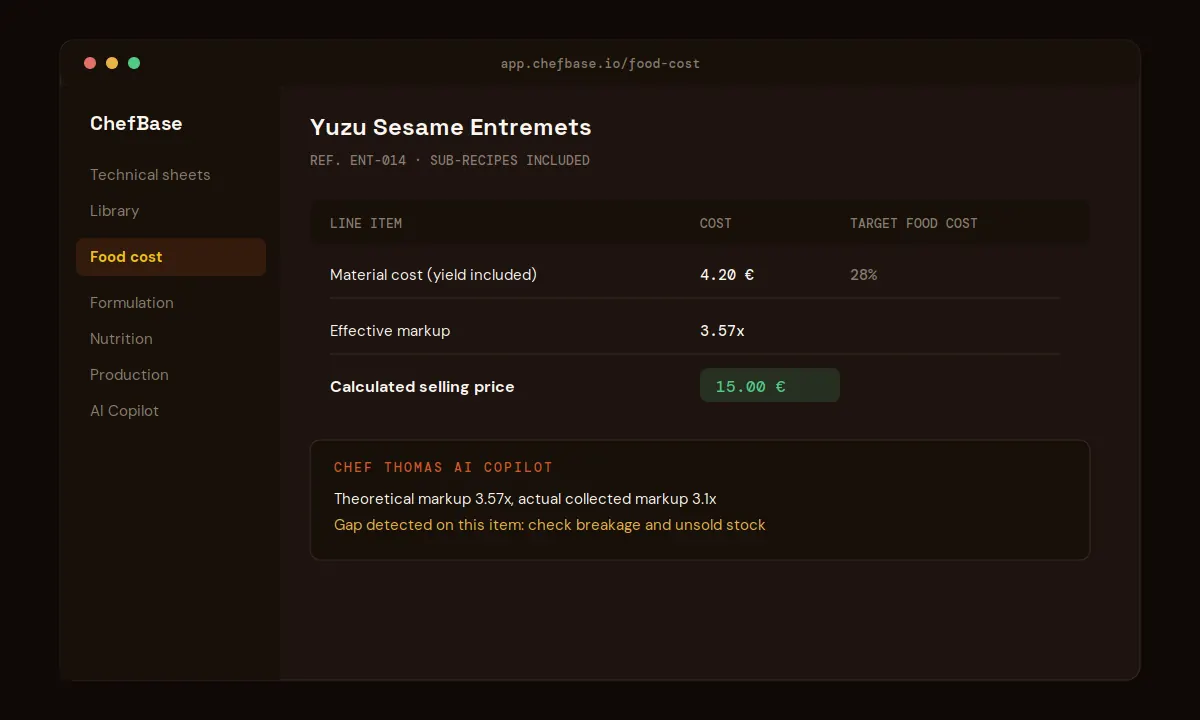
A markup calculated on a technical sheet stays theoretical until it’s checked against actual sales. Breakage, unsold stock, giveaways, and portion drift reduce the effective markup without the sheet ever changing. That’s exactly the gap documented in our article on real versus theoretical margin in pastry.
ChefBase calculates the markup from the real food cost of each technical sheet, sub-recipes included, and lets you track the gap between theoretical markup and actual collected markup, product by product.
Key takeaway: the pricing markup is not a universal constant. It’s calibrated by positioning, sales channel, and product, starting from a correctly calculated food cost, then verified against real margin.