Too many chefs price by instinct and find out too late they were selling at a loss. Food cost fixes that in five steps. Here’s the quick-start method: enough to price with confidence today, with a link to the full line-by-line method when you’re ready to go deeper.
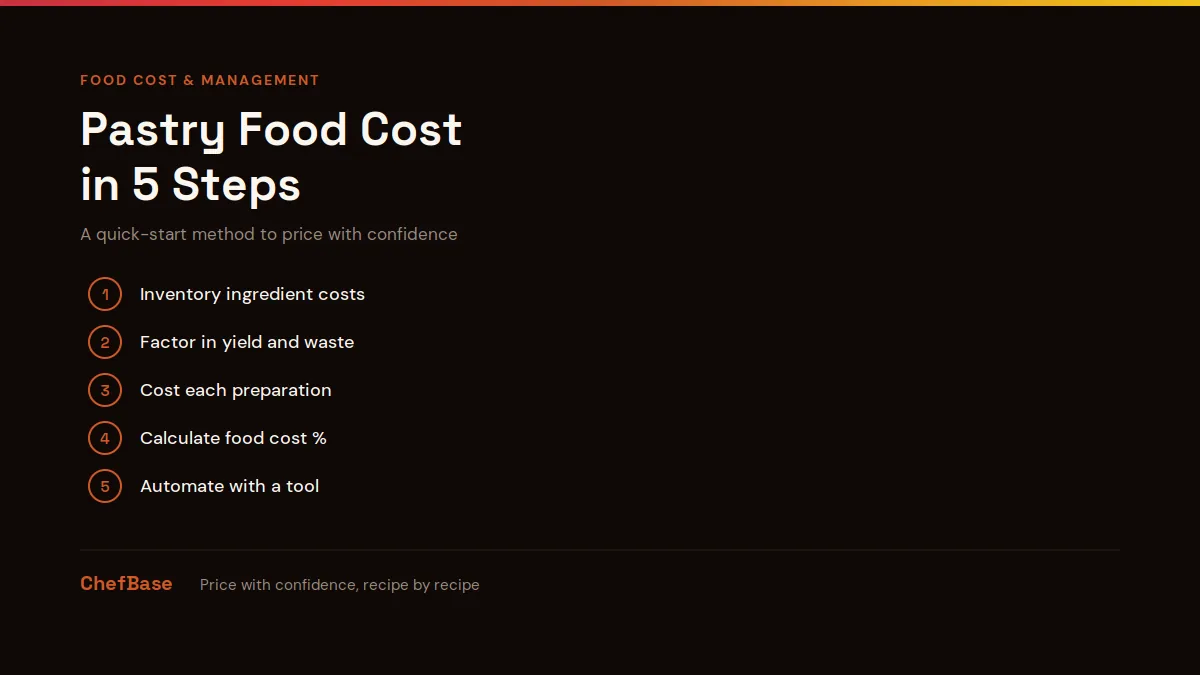
Step 1: Inventory Every Ingredient’s Real Price
Start with a reliable ingredient database. For each one, record the net unit price (excluding tax), the purchase unit (kg, L, piece) and the supplier. Prices move: update your records after every delivery, not once a quarter.
Step 2: Factor In Yield and Waste
A kilo (2.2 lb) of purchased strawberries doesn’t yield a kilo (2.2 lb) usable. Hulling loses about 15%. Peeling apples loses 20 to 25%. Apply these yield coefficients systematically, or your food cost stays underestimated by design.
Step 3: Cost Each Preparation
For every recipe or sub-recipe, multiply the quantity used by the unit cost (adjusted for yield), then add up every ingredient. That total is your raw material cost. Don’t forget packaging: box, film, label.
Step 4: Calculate Your Food Cost Percentage
Food cost % = (material cost / selling price excluding tax) x 100. In artisan pastry, 25 to 32% is healthy. Above 35%, your margin no longer covers fixed costs. Below 20%, check that your prices still match the market.
Step 5: Automate With a Dedicated Tool
Running this by hand in a spreadsheet is slow and error-prone the moment a supplier price changes. ChefBase calculates the cost price of every recipe in real time, applies yields automatically, and flags you the moment a price change hits your margin.
This 5-step method gets you a reliable food cost fast. For the full method, including weighted average cost, baking loss and real labor cost, see our detailed guide: Pastry Food Cost: How to Calculate Your Real Cost Price, Line by Line.
Key takeaway: food cost isn’t a constraint, it’s a management tool. Master these 5 steps and you can set your prices with confidence, every time.