A 28% food cost on paper and a margin that doesn’t hold at the till: the problem is almost never the selling price, it’s the raw material cost calculation itself, too often reduced to a simple division.
Food cost isn’t a single ratio. It’s a cascade: net yield, weighted average cost, cost after baking loss, real labor cost, then multiplier coefficient. Here is the complete method, line by line.

Separate Raw Material Food Cost From Full Cost Price
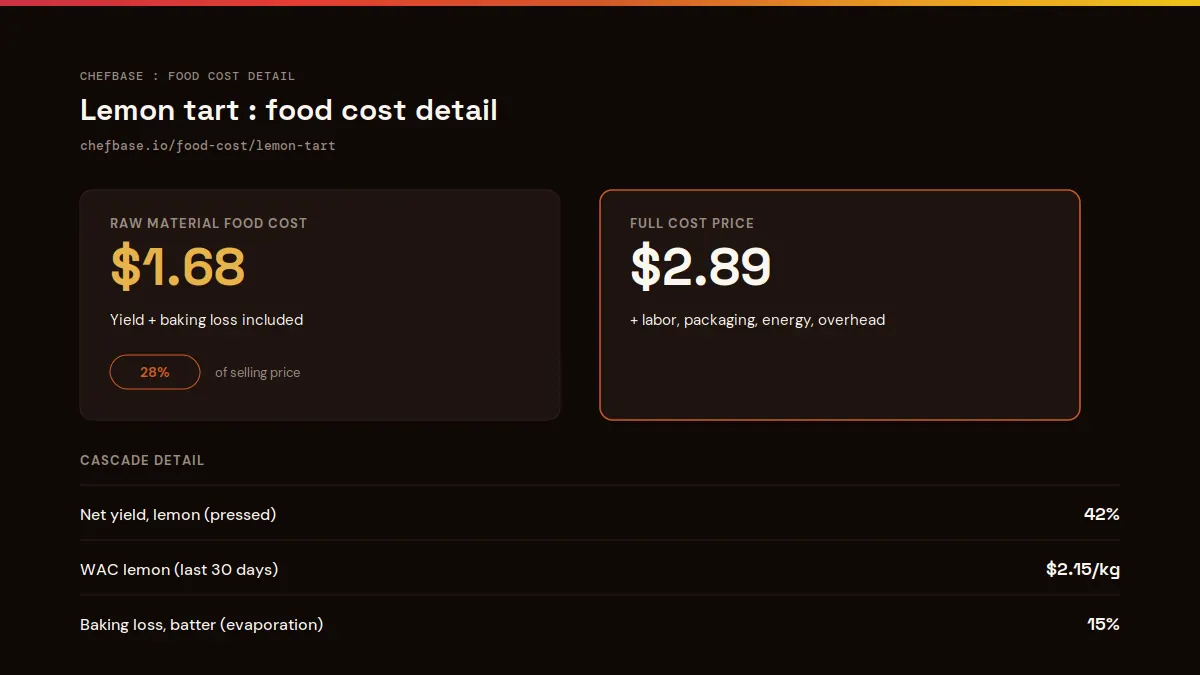
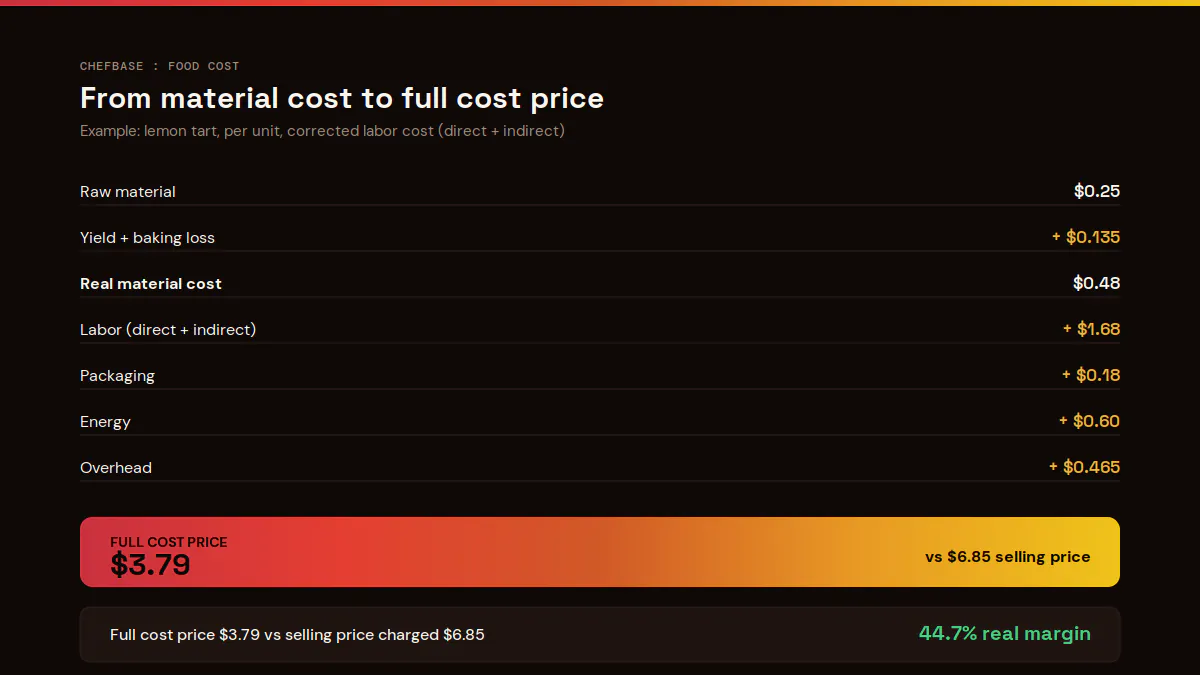
Raw Material Food Cost (RMFC) only covers ingredient cost after yield. Full cost price adds labor, packaging, energy and overhead. A kitchen that steers only on RMFC systematically underestimates its real cost, often by 8 to 15 points depending on the structure. Both indicators must be tracked separately, never merged into one figure.
Calculate Net Yield, Not Purchased Weight
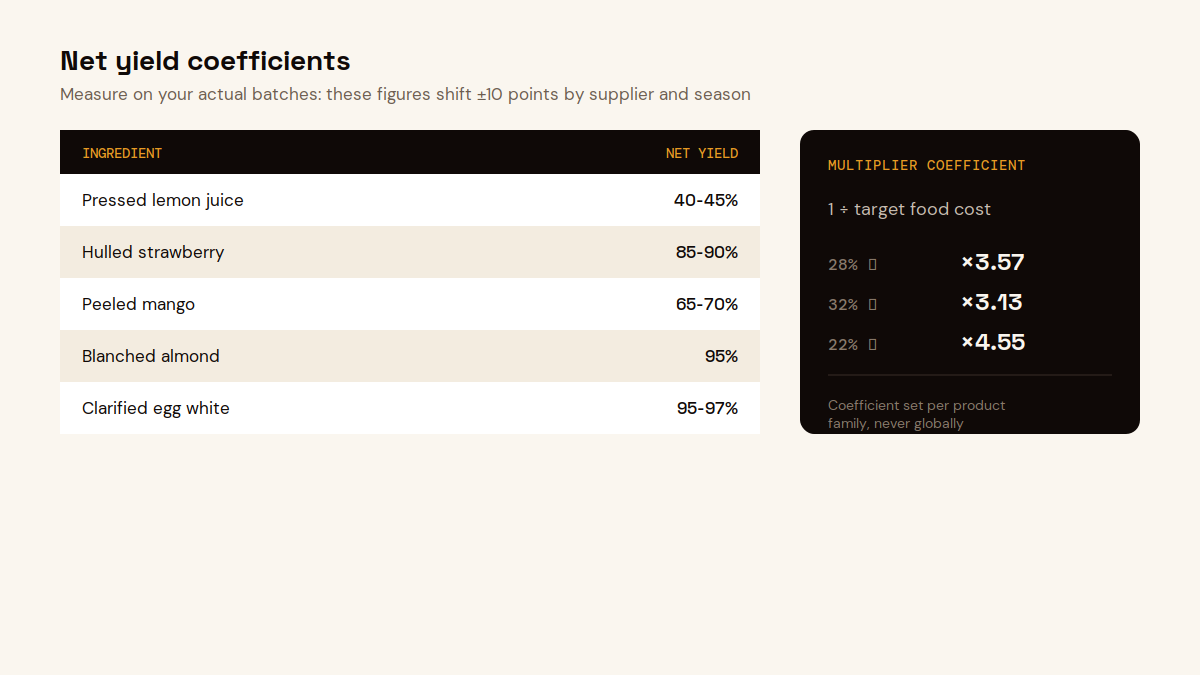
Net yield (%) = (usable net weight ÷ purchased gross weight) × 100. These coefficients aren’t universal constants: measure them on your actual batches, a supplier can shift yield by 10 points from one delivery to the next.
Use Weighted Average Cost to Smooth Supplier Variations
Weighted average cost (WAC) = Σ(quantity purchased × unit price) ÷ Σ(quantities purchased) over a given period. Without WAC, one price spike (butter during a supply squeeze, vanilla) skews the food cost of a whole recipe for weeks.
Factor Baking Loss Into Your Unit Cost
Real cost per kilo = committed material cost ÷ finished weight after baking. A 1,000 g (2.2 lb) batch that comes out at 850 g (1.87 lb) sees its cost per kilo climb mechanically, with no ingredient price change at all. This recalculation must be done recipe by recipe, not globally.
Calculate Real Labor Cost, Not Just the Visible Task
A common mistake: timing only the direct task on the recipe (weighing, shaping, baking, finishing) and ignoring indirect time (station cleaning, shared base preparation, management), which is real and paid. The loaded hourly rate must also be calculated on actually productive hours (paid hours minus paid leave, public holidays, absences), not contract hours: dividing by paid hours underestimates the real rate by about 15%.
Unit labor cost = [(direct time + share of indirect time) ÷ 60] × loaded hourly rate on productive hours. On a batch of 12 lemon tarts, the direct timed task (46 min) plus a 20% share of indirect time brings the real cost to $1.55 per piece, against $0.82 if only the visible gesture is counted: nearly half underestimated. Figures are shown in USD as a reference, adapt them to your own currency.
Apply the Multiplier Coefficient, Not a Gut-Feel Margin
Multiplier coefficient = 1 ÷ target food cost. A 28% target food cost on RMFC gives a coefficient of 3.57. A high-end kitchen (noble ingredients, technical labor) often targets 30 to 33%; a high-turnover viennoiserie offer can go down to 22-25%. The coefficient should be set by product family, never uniformly across the whole menu.
Track Food Cost Continuously, With an Alert Threshold
Recalculate on any significant supplier variation (over 5% on an ingredient weighing more than 10% of material cost) and review the full menu at least monthly. A gap over 3 points between theoretical and real food cost signals an untracked loss (yield, breakage, unsold stock) that needs identifying before touching the price.
This calculation always starts from an up-to-date technical sheet, yield and WAC included. ChefBase automates this cascade: net yield per ingredient, WAC recalculated on each delivery, baking cost included, direct and indirect time valued at the loaded hourly rate, and multiplier coefficient applied by product family, no spreadsheet to maintain by hand.
Key takeaway
Food cost is built as a cascade: net yield, supplier WAC, cost after baking, real labor cost (direct and indirect), then multiplier coefficient. Always separate raw material food cost from full cost price. Recalculate as soon as a supplier price moves more than 5% on a significant ingredient.
FAQ
What is the difference between raw material food cost and full cost price in pastry?
Raw material food cost (RMFC) only covers ingredient cost after yield; full cost price adds labor, packaging, energy and overhead, and exceeds RMFC by 8 to 15 points depending on the kitchen’s structure.
How do you calculate the net yield of an ingredient in pastry?
Net yield is calculated as (usable net weight ÷ purchased gross weight) × 100. It should be measured on actual batches, since it varies by supplier and season, for example 40 to 45% for pressed lemon juice or 85 to 90% for hulled strawberries.
What is weighted average cost and why use it in food cost calculation?
Weighted average cost (WAC) smooths the price of an ingredient bought at varying rates over a period, by weighting each price by the quantity purchased, which prevents a single price spike from skewing a recipe’s entire food cost for weeks.
How do you calculate the multiplier coefficient in pastry?
The multiplier coefficient is obtained with 1 ÷ target food cost: for a 28% target food cost, the coefficient is 3.57, and the selling price is obtained by multiplying the real material cost by this coefficient. It should be set by product family, not uniformly across the menu.
How do you calculate real labor cost per product in pastry?
Real labor cost is obtained by adding the direct time timed on the recipe and a share of indirect time (cleaning, shared bases, management), then multiplying this total time by a loaded hourly rate calculated on actually productive hours. Ignoring indirect time typically underestimates labor cost by nearly half.
What software can automate pastry food cost calculation?
ChefBase automates food cost calculation by integrating net yield per ingredient, WAC recalculated on each delivery, cost after baking loss, real labor cost (direct and indirect) and multiplier coefficient by product family, replacing manual spreadsheet tracking.