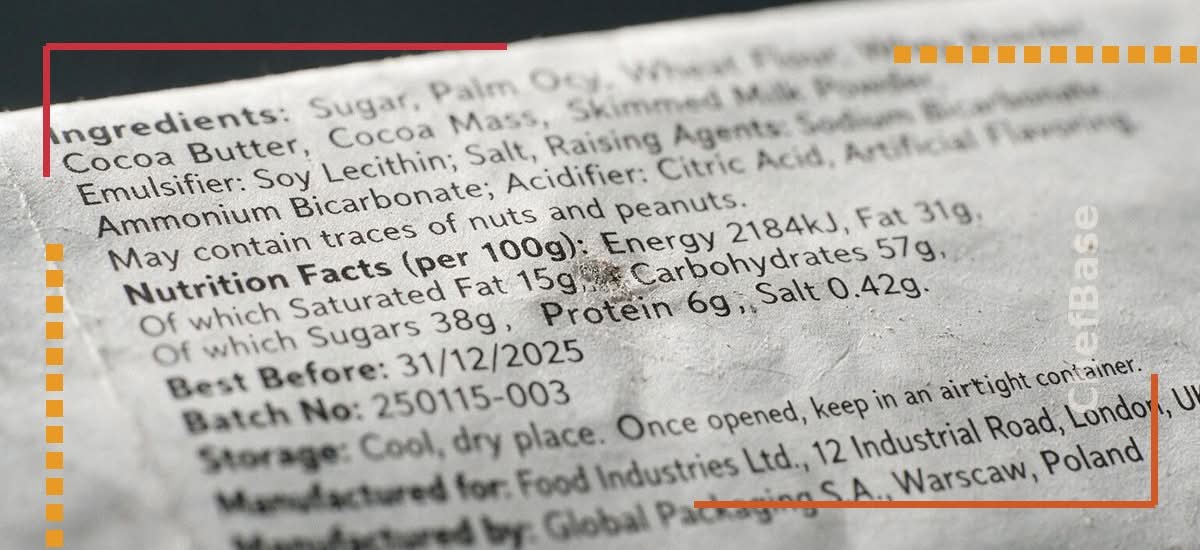
The 14 allergens requiring mandatory declaration are easy to check: they are known, listed, one by one. The real risk doesn’t come from them. It comes from hidden allergens in the composed ingredients you buy ready-made, without ever breaking them down yourself.
The 14 INCO allergens are not the problem
In a pastry kitchen producing 40 to 80 references, every ingredient change theoretically requires rechecking every affected recipe card. In practice, no one has time to redo everything by hand with every raw material delivery. The risk isn’t bad intent: it’s volume.
A supplier changes the formulation of a fruit paste, and the information is never passed on to the 12 recipes that use it. The 14 allergens under the INCO regulation are known, listed, easy to check one by one. The real risk lies elsewhere: in what your purchased ingredients actually contain.
What is a hidden allergen?
A hidden allergen is an allergen present in a composed ingredient, bought as-is, but invisible in the final recipe. It appears nowhere until someone opens the technical sheet for that specific ingredient.
Three examples come up most often in professional pastry:
- A baking powder can contain gluten, without it being visible on the finished product’s commercial label
- A food coloring can carry traces of tree nuts through its production line, without any tree nut actually entering its formula
- An industrial praline paste can contain milk powder that isn’t obvious to the eye, mixed in with ground almonds and hazelnuts
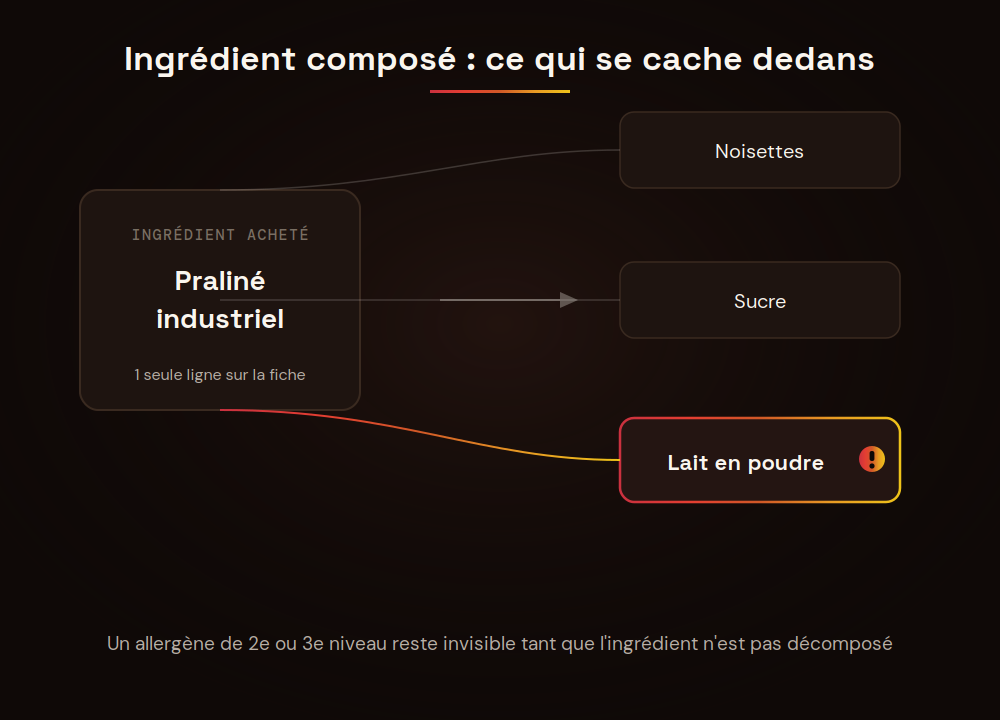
These second- or third-level allergens are the ones that most often slip past a paper checklist, because they are never directly visible in the final recipe: they are buried inside a composed ingredient bought ready-made.
Why a paper checklist misses them every time
A paper checklist lists what appears in the recipe: flour, butter, eggs, praline paste. It never lists what the praline paste itself actually contains. To know that, you’d have to reopen the supplier’s technical sheet at every check, which no one does systematically.
Control then relies on the team’s memory: someone remembers, or doesn’t, that a given praline paste contains milk. That memory doesn’t survive a staff change or a supplier change.
How to trace them: an allergen sheet per purchased ingredient
The only reliable way to never miss a hidden allergen is to document every purchased ingredient at the source, with its own allergen sheet, before it goes into a single recipe. In ChefBase, this sheet exists at the ingredient level itself: it doesn’t depend on any particular recipe.
A sub-recipe that uses this ingredient automatically inherits its allergens. A final technical sheet in turn inherits from all its sub-recipes. The hidden allergen in the praline paste becomes visible everywhere it’s used, without a single chef having to re-enter it recipe by recipe.
The real test: the supplier changes its formula
The real difficulty isn’t the first declaration: it’s what happens when a supplier changes the composition of an ingredient already used in ten or twelve recipes. On a paper checklist, that change isn’t reflected anywhere until someone reopens every sheet one by one.
By documenting the allergen at the ingredient level, a single change is enough: you edit that ingredient’s sheet, and every sub-recipe and technical sheet that depends on it updates automatically. No sheet is forgotten, because none needs to be reopened manually.
What it changes day to day
For a team managing 50 technical sheets, that’s the difference between several hours of checking with every supplier change and a single centralized edit. Above all, it’s the guarantee that no label ever goes out to the dining room or the shop missing a second-level allergen.
In the event of a health inspection, this traceability protects both allergic customers and the business: every hidden allergen is documented at its source, not reconstructed from memory during the inspection.
Key takeaways
- The 14 INCO allergens are known: the real risk comes from composed ingredients bought ready-made
- A hidden allergen is invisible in the final recipe, buried inside a purchased ingredient
- A paper checklist never lists what a composed ingredient actually contains
- Documenting the allergen at the ingredient level makes it visible in every recipe that uses it
- A supplier change updates every affected sheet, with no manual re-entry
To go further, ChefBase shows how the allergen mention is automatically generated from the technical sheet all the way to the label, and how to manage the allergen matrix and cross-contamination in the kitchen.
Frequently asked questions
What is a hidden allergen in pastry?
A hidden allergen is an allergen present in a composed ingredient bought as-is, such as a praline paste or a baking powder, without being directly visible in the final recipe.
How do you know if a composed ingredient contains an undeclared allergen?
You need to document every purchased ingredient with its own allergen sheet at the source, rather than relying on what’s visible in the final recipe.
Does almond paste always contain tree nuts?
Yes, almond paste by definition contains almonds, a tree nut. Any recipe that uses it must inherit that allergen, even if the ingredient appears only in a small quantity.
Can an industrial praline paste contain milk without it being visible on the packaging?
Yes, some industrial praline pastes contain milk powder mixed in with dried nuts, information that appears on the supplier’s technical sheet but rarely on the commercial packaging visible in the kitchen.
How can you trace hidden allergens without redoing every sheet by hand?
By documenting the allergen once at the ingredient level in a tool like ChefBase, which then automatically carries it through to every sub-recipe and technical sheet involved.