
A forgotten trace of egg in a praline base used across three different desserts: that is what triggers a product recall or an allergic reaction, not ignorance of the law. Here is how to structure allergen management that holds up once a single preparation feeds into multiple recipes.
Map your allergens by sub-recipe, not by finished product
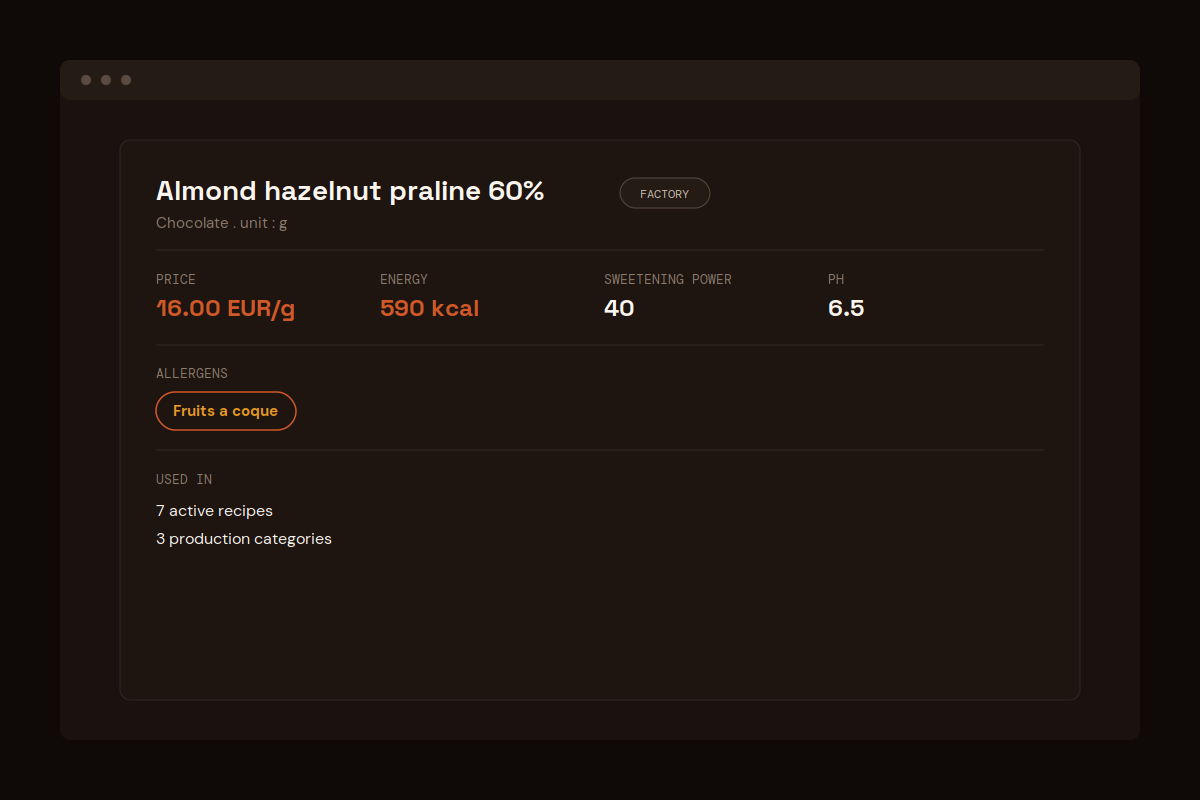
Most mistakes come from declaring allergens at the finished-product level without tracing back to the sub-recipes that compose it. A house-made praline used in an entremets, a filling, and a biscuit carries its allergens (tree nuts) into every product it touches. Change its composition, and all three desserts need updating at the same time.
The correct approach: build an allergen matrix at the ingredient and sub-recipe level, then let it inherit automatically up to the finished product. Without that automatic inheritance, every composition change forces a manual recheck of every affected recipe, which only holds up with a very small menu.
Catch the hidden allergens that visual checks miss
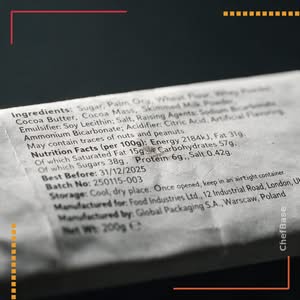
The obvious allergens (egg, milk, gluten, tree nuts) are rarely forgotten. The real risk comes from hidden allergens: sulfites in dried fruit or cooking wine, tree nut traces in an industrial spread, gluten in a flavor enhancer or powdered coloring. These cross-cutting ingredients are the ones that escape a visual check most often.
A technical sheet that only references the major allergens without detailing each purchased ingredient, backed by its own supplier allergen data sheet, leaves this risk open. The reliability of your declaration depends directly on the reliability of your supplier product sheets, which need updating every time a reference changes.
Control cross-contamination on the production floor
Declaring intentional allergens does not cover cross-contamination: traces of an allergen present despite its absence from the recipe, caused by a shared workstation, a utensil, or a fryer. In pastry, the most frequent risk involves tree nuts (almond flour, praline) and gluten (airborne flour).
Three levers limit this risk: separating production zones for major allergens when volume justifies it, cleaning and swapping utensils between two preparations with different allergen profiles, and training the team to recognize risky contact points (a shared spatula, a floured worktop, a shared finishing station). Without a written procedure, this control depends on each person’s memory, which does not survive a staff change or a rush.
Train your team on allergen declaration, not just the recipe
A commis who knows a recipe by heart does not necessarily know which allergens it carries once transformed. Training needs to cover three reflexes: never improvise an ingredient substitution without checking its allergen profile, report any supplier or reference change immediately, and know how to answer a customer asking for the allergen list of a specific product, including at the counter.
In the US, this sits on top of FDA labeling requirements for the nine major food allergens (milk, eggs, fish, shellfish, tree nuts, peanuts, wheat, soybeans, and sesame). In the UK, Natasha’s Law adds a separate obligation: full ingredient and allergen labeling on all pre-packed for direct sale (PPDS) items, which covers most bakery and pastry counter sales. Neither framework replaces the other where a business operates across both markets, and the operational question stays the same regardless of jurisdiction: can your kitchen prove, at any moment, which allergens are in a given product and why.
Automate allergen roll-up from the technical sheet
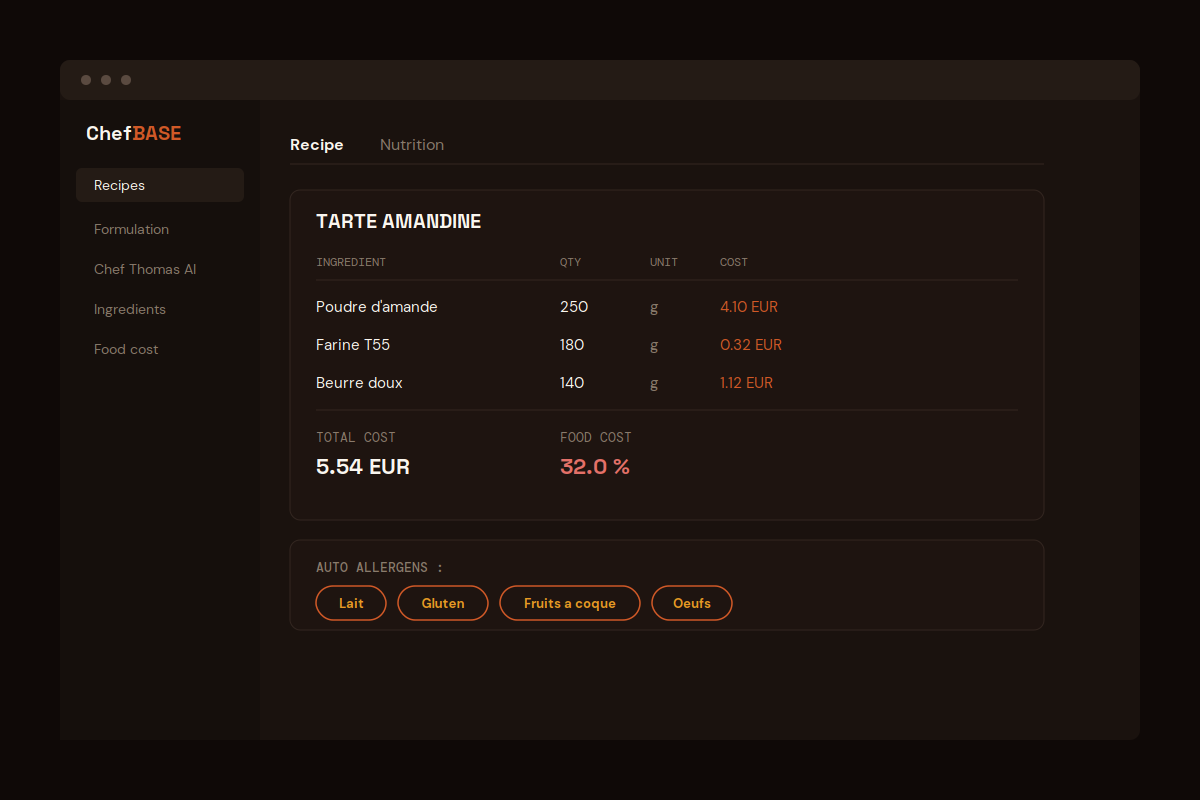
The most reliable method is to carry allergen information on the ingredient itself, then let it roll up automatically through every sub-recipe and finished product that uses it. Change one ingredient in a base, and its allergen declaration updates everywhere it is used, with no re-entry and no gaps.
This is exactly what ChefBase does: every ingredient carries its allergens, every sub-recipe inherits from its components, and every final technical sheet displays an up-to-date declaration in real time, even when the sub-recipe feeds several desserts at once. You can find the full structuring logic in our pastry technical sheet guide.
Key takeaway: declare allergens at the ingredient and sub-recipe level, not only at the finished-product level. Hidden allergens (sulfites, industrial traces) and cross-contamination are the two most common blind spots. A technical sheet that rolls up the information automatically removes the risk of a missed update every time a recipe changes.
This is what the Labeling feature handles natively: allergens declared once, inherited through every sub-recipe.
Cross-contamination risk shouldn’t depend on someone remembering to update a matrix. ChefBase rolls it up automatically. Try it free, no card required.
Frequently asked questions
How do you declare allergens when a sub-recipe feeds several desserts?
Declare the allergen at the ingredient and sub-recipe level itself, then let that information roll up automatically into every finished product that uses it. Without that automatic inheritance, a change in the sub-recipe forces a manual recheck of every affected dessert, which becomes unmanageable past a handful of references.
What are the most commonly missed hidden allergens in pastry?
Sulfites in dried fruit or cooking wine, tree nut traces in industrial spreads, and gluten present in some flavor enhancers or powdered colorings. These cross-cutting ingredients escape visual checks because they sit in a secondary purchased component, not the main ingredient.
What is cross-contamination in pastry and how do you limit it?
Cross-contamination is the unintended presence of an allergen in a product that does not contain it in its recipe, caused by a shared workstation, utensil, or piece of equipment. It is limited by separating production zones for major allergens, swapping utensils between preparations with different allergen profiles, and training the team to spot risky contact points.
Does the whole team need allergen training, or just the head chef?
Everyone who handles recipes needs to know the allergen profile of what they are preparing, not just the head chef. A commis who improvises an ingredient substitution without checking its allergen profile can introduce an undeclared risk, even if the base recipe is perfectly controlled.
How do FDA rules and Natasha’s Law both apply to allergen labeling?
FDA rules require labeling for the nine major food allergens on packaged food sold in the US. Natasha’s Law requires full ingredient and allergen labeling on pre-packed for direct sale (PPDS) items in the UK, which covers most bakery counter sales. A business operating in both markets needs to meet both frameworks, since neither replaces the other.