Sell a cake by the slice, a boxed macaron, or a plated dessert online: you already fall under nutrition labeling and allergen rules, packaging or not. Get it wrong and the exposure is real: FDA warning letters in the US, fines up to €375,000 in the EU, and the reputational cost of an allergic incident. Here is what US, EU and UK rules actually require in 2026, and how to keep labels current without a lab test for every recipe change.
Know the US rules first: FDA Nutrition Facts
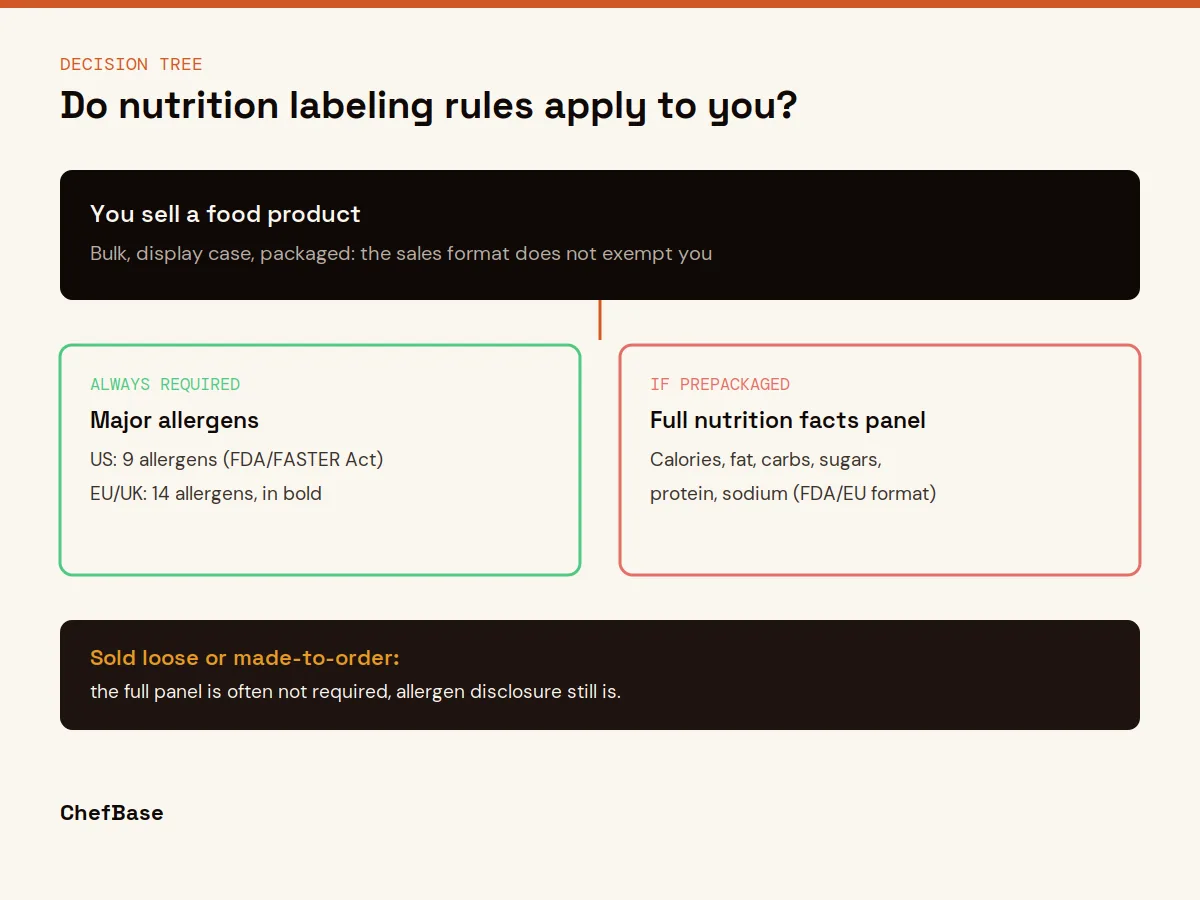
In the United States, the FDA requires a Nutrition Facts panel on packaged food, covering calories, total fat, saturated fat, trans fat, cholesterol, sodium, total carbohydrate, fiber, total and added sugars, and protein. A small business exemption exists for retailers with low annual food sales, but it only covers the label itself, not allergen disclosure, which applies regardless of size.
Since 2023, under the FASTER Act, sesame is the ninth major allergen requiring mandatory disclosure in the US, alongside milk, eggs, fish, shellfish, tree nuts, peanuts, wheat and soybeans. This one catches bakeries off guard: praline pastes and nut-adjacent bases often carry sesame traces that were not tracked before the rule changed.
Layer in EU and UK rules if you sell internationally
In the European Union, the INCO regulation (EU 1169/2011) requires a full nutrition declaration (energy, fat, saturates, carbohydrate, sugars, protein, salt) on prepackaged food, and mandatory disclosure of 14 major allergens on every product, prepackaged or not, including items sold loose or made to order. In France specifically, a November 2025 amendment adopted as part of the 2026 social security budget bill (PLFSS) would make Nutri-Score mandatory on food packaging. It is not yet finalized, but the underlying scoring algorithm was already tightened in March 2025, which pushed down scores for sugary, high-fat products, a category that includes most pastry.
In the United Kingdom, Natasha’s Law has required full ingredient lists with allergens in bold on all PPDS (Prepacked for Direct Sale) food since October 2021. This rule hits bakeries and hotel pastry kitchens directly: any item made on-site and packed before a customer selects it counts as PPDS, even a sandwich or a slice of cake wrapped at the counter.
Calculate nutrition values without a lab test
Both US and EU frameworks allow nutrition values to be calculated from ingredient composition and quantities, using reliable, up-to-date composition data, instead of requiring lab analysis for every product. This is the only realistic method for a kitchen that updates recipes often: outsourced lab analysis typically runs 300 to 500 € per recipe, and has to be redone every time a formulation changes.
The calculation method has one hard requirement: your technical sheets need accurate yields (a fruit paste loses water on cooking, softened butter does not weigh the same as cold weighed butter), and any change to a sub-recipe used across multiple desserts has to propagate everywhere it is used. That is exactly what ChefBase does: nutrition values and allergens are generated directly from the technical sheet, recalculated automatically whenever an ingredient or quantity changes, with no manual re-entry and no missed sub-recipe.

Avoid the penalties
In the EU, national authorities such as France’s DGCCRF can fine a business up to €375,000 for labeling violations, on top of forced product withdrawal. Across the EU, more than 4,000 food recalls were recorded in a single year, roughly 30% linked to labeling errors, undeclared allergens being the most common cause. In the US, FDA warning letters and product seizures follow the same logic. Beyond the fine, an allergic incident at your establishment remains the costliest outcome, for the guest and for your reputation.
Key takeaway: allergen disclosure is mandatory everywhere you sell, packaged or not, US, EU or UK. The full nutrition panel is only required on prepackaged goods, but UK PPDS rules and a possible French Nutri-Score mandate both widen what counts as “packaged.” Calculating values from an accurate, always-current technical sheet, instead of a lab test per recipe, is what keeps this manageable as your menu changes.
Frequently asked questions
Is a nutrition label legally required for a bakery or pastry shop?
Allergen disclosure is required everywhere you sell, packaged or not, in the US, EU and UK. A full nutrition facts panel is generally required only on prepackaged food: FDA rules in the US, INCO in the EU, and Natasha’s Law (PPDS) in the UK, which also covers items packed on-site before a customer picks them.
What are the major allergens that must be declared on a food label?
The FDA requires disclosure of nine major allergens in the US (milk, eggs, fish, shellfish, tree nuts, peanuts, wheat, soybeans, and sesame since 2023). The EU’s INCO regulation requires 14, including gluten, eggs, milk, tree nuts, soy and sesame, highlighted in the ingredient list through bold, capitals or a different typeface.
Is Nutri-Score mandatory in France or the EU?
Nutri-Score is currently voluntary at EU level. In France, an amendment making it mandatory was adopted by the National Assembly in November 2025 as part of the 2026 social security budget bill, but it is not yet finalized. The scoring algorithm itself was already tightened in March 2025, lowering scores for sugary and high-fat products.
How do you calculate nutrition facts for a pastry recipe without a lab?
Both FDA and EU rules allow nutrition values to be calculated from ingredient composition and quantities using reliable database values, instead of mandatory lab testing. ChefBase automates this calculation directly from the technical sheet, recalculating automatically whenever an ingredient or sub-recipe changes.
What happens if a bakery’s food label is not compliant?
In the EU, authorities such as France’s DGCCRF can fine a business up to €375,000 for non-compliant labeling, in addition to forced product withdrawal. Around 30% of EU food recalls are linked to labeling errors, most often undeclared allergens. In the US, non-compliance can trigger FDA warning letters and product seizures.