

A ganache that splits, a cream that separates: you change a random step and hope it works next time. But a failed emulsion is never really random. And the worst part is that the flaw doesn’t always show up right away: it’s often after freezing, then thawing, that a fragile emulsion finally separates. A poorly stabilized emulsion always separates eventually, sooner or later. Understanding its structure lets you stop guessing.
Understand What an Emulsion Actually Is
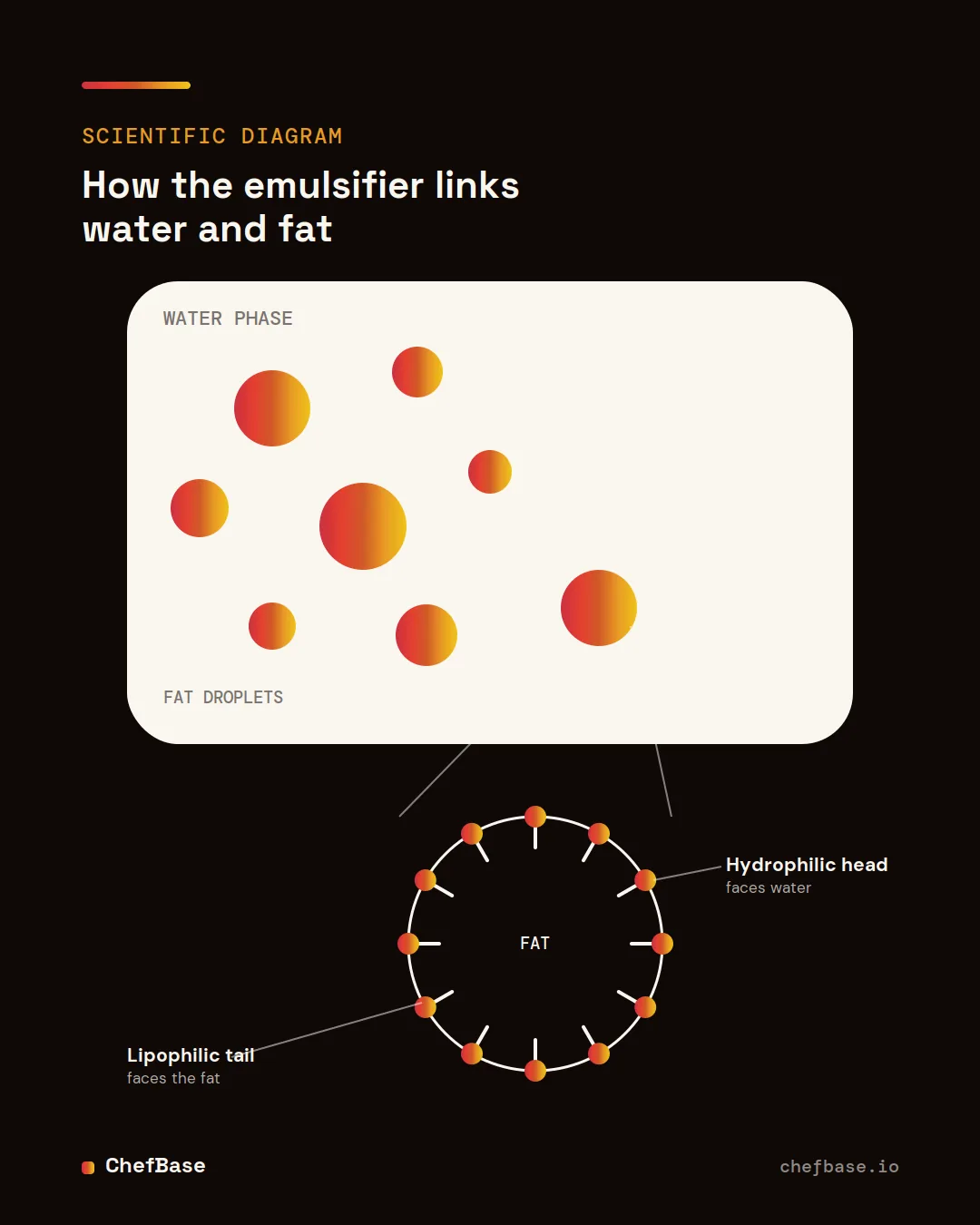
An emulsion is two phases that don’t naturally mix (water and fat) held together by an emulsifying agent. Without that agent, the two phases separate as soon as agitation stops. The emulsifier is a molecule with two ends: a hydrophilic head that binds to water, and a lipophilic tail that binds to fat. It positions itself at the interface between the two phases and prevents them from recombining.
Tell the 2 Types of Emulsion Apart
An oil-in-water emulsion disperses fat droplets in a continuous aqueous phase (pastry cream, whipped ganache). A water-in-oil emulsion does the opposite: water droplets dispersed in a continuous fat phase (butter, certain creams). The final texture, mouthfeel, and cold stability differ depending on the type.
Identify the Agents That Stabilize an Emulsion
Egg yolk lecithin is the best known in pastry, but it’s not the only one: milk proteins, soy lecithin, and sunflower lecithin play the same binding role between water and fat. Alongside direct emulsifiers, thickeners play an indirect but real role: by increasing the mass’s viscosity, they slow down droplet movement and make the emulsion easier to stabilize, without acting at the water/fat interface themselves.
Identify the Levers That Stabilize an Emulsion
Five factors determine whether your emulsion holds: the temperature of both phases at mixing time, the incorporation speed, the water/fat ratio, the choice and dosage of the emulsifier, and the order of incorporation. None of them is secondary: getting just one of these levers wrong is enough to destabilize the whole recipe, even if the ingredient quantities are otherwise correct.

Rescue an Emulsion That Has Started to Split
An emulsion that starts splitting isn’t always lost. The most useful reflex is to slow down: stop adding the fat or water phase, go back to a smaller, already stable base, then gradually reincorporate the rest while working at a temperature closer to that of the base. This rescue has limits: past a certain degree of separation, it’s more reliable to reformulate than to try to save it.
Check the Water / Fat Balance of Your Recipe
The imbalance between water and fat is one of the most frequent causes of an unstable emulsion, and one of the easiest to fix once you can visualize it. ChefBase’s Formulation module automatically displays the water / fat / sugar breakdown of each recipe and flags when it falls outside the stable range, so you can adjust an ingredient before even testing in the lab.

Key takeaway
An emulsion splits for a precise reason, never by accident. Identify the continuous and dispersed phases, spot the emulsifier at work, and check the 5 levers (temperature, speed, ratio, agent, order) before trying again blindly.
To go further on formulation logic, read our article on the texture-first method.
FAQ: Emulsion in Pastry
Why does an emulsion split?
An emulsion splits when one of the stability levers is off: phases too far apart in temperature, incorporation too fast, an unbalanced water/fat ratio, insufficient emulsifier, or the wrong order of incorporation.
What is the difference between a water-in-oil and an oil-in-water emulsion?
In an oil-in-water emulsion, fat droplets are dispersed in a continuous aqueous phase (pastry cream). In a water-in-oil emulsion, it’s the opposite: water droplets dispersed in a continuous fat phase (butter).
What emulsifying agents are used in pastry?
Egg yolk lecithin, milk proteins, soy lecithin, and sunflower lecithin are the most common. Thickeners aren’t direct emulsifiers, but they stabilize indirectly by increasing the mass’s viscosity.
Why does an unstable emulsion often separate after freezing?
Ice crystal formation during freezing, followed by melting during thawing, puts mechanical stress on the emulsion’s structure. A fragile emulsion that seemed stable at room temperature then reveals its instability.
Can you rescue an emulsion that has started to split?
Yes, to some extent: slow down incorporation, go back to a smaller, already stable base, then gradually reincorporate the rest. Past a certain degree of separation, it’s more reliable to reformulate than to try to rescue it.

