
A pastry technical sheet is more than a tidy recipe. It is the tool that standardizes your preparations, calculates your real food cost and protects your margins. Without one, you price by guesswork. Here is a free Excel template, ready to fill in, and more importantly: how far it takes you before it hits its limits.
This template follows the structure explained in our complete pastry technical sheet guide. For the digital version, see build your recipe card in 5 minutes.
Download and fill in the template
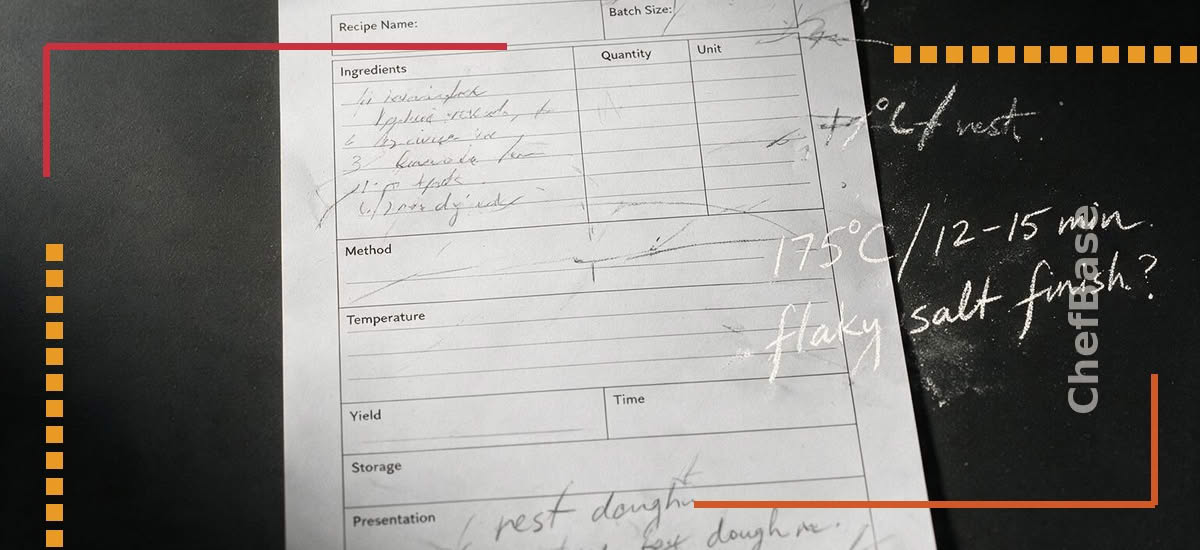
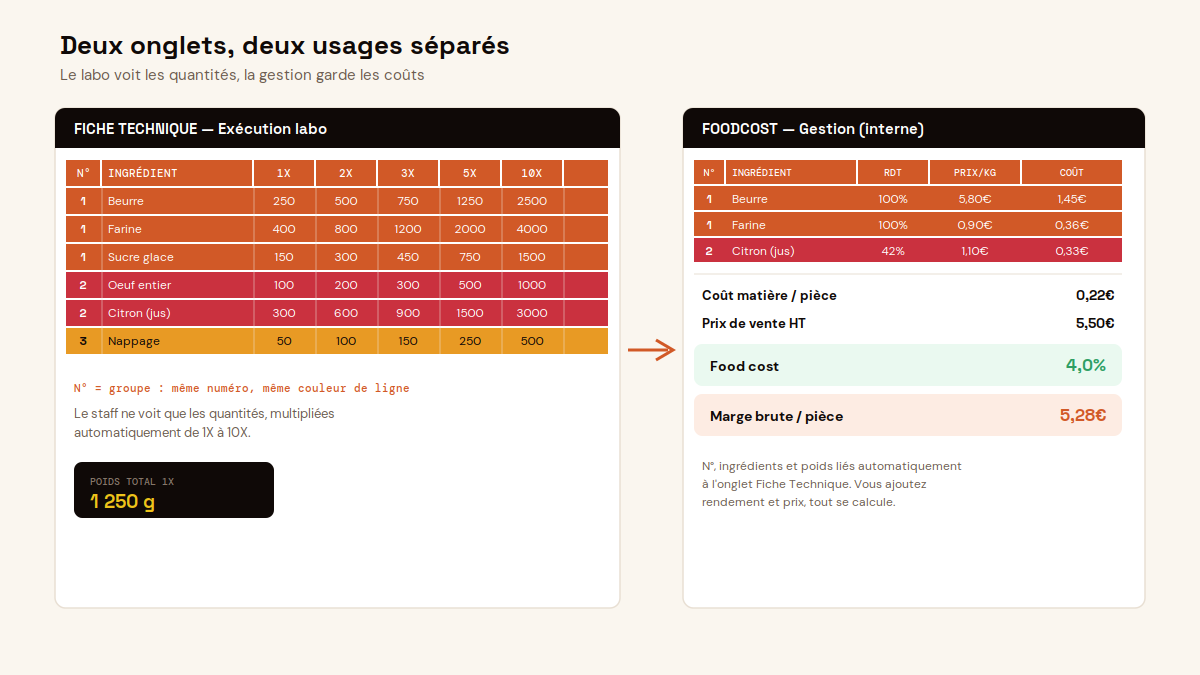
The template has two separate tabs. The Technical sheet tab is for production: recipe name, ingredient list, quantities for one piece, then multiples calculated automatically (2X, 3X, 5X, 10X) and a method column. Your team sees only the quantities, never the prices.
The Food cost tab is for management. It pulls in the ingredients from the sheet automatically, adds the net yield (the share actually usable after peeling, juicing, trimming), the price per kilo, and calculates the food cost per piece, the food cost percentage, the margin and the coefficient. You enter, the file calculates.
Group your steps with color-coded numbers
The No. column groups ingredients by step or by preparation: the crunchy layer, the ganache, the sponge. Each number triggers a color across the whole row. The result: at a glance, your team spots the recipe blocks without reading every label. It is standard conditional formatting, and it works in Excel as well as in Google Sheets.
Spot the moment the file breaks
Take a sweet shortcrust pastry. You use it in your lemon tart, your chocolate tart and your fruit tartlets. With this template, you re-enter it in three separate sheets. The day butter prices rise, you have to correct the cost in all three files, by hand, without missing one. That is where the spreadsheet shows its limit: it handles an isolated recipe, not a preparation shared across several recipes.

Know when an isolated file is no longer enough
As long as you manage a few independent recipes, the spreadsheet holds. As soon as you have shared bases (a cream, a praline, a streusel reused everywhere) and your prices move, the isolated file wastes time and introduces errors. Every re-entered price is a chance to make a mistake. That is the threshold where a shared preparation must live in a single place, linked to every recipe that uses it.
This is exactly what pastry management software handles: the sub-recipe exists once, and any price change flows automatically into every finished recipe. You correct the butter once, ChefBase recalculates everywhere.
Measure the true cost of a sheet that drifts
A technical sheet that is no longer up to date costs you money, quietly. You price on a food cost from six months ago, while your purchase prices have climbed 12%. Your margin melts and nothing flags it. A spreadsheet never warns you: it shows what you last entered. That is the tipping point where tracking real margin versus theoretical margin becomes decisive for your profitability.

Fill in the pastry recipe template column by column
A pastry recipe template only gives accurate numbers if each column gets the right kind of data. On the Technical sheet tab, fill in:
- Recipe name: the precise internal name, with size (“Lemon meringue tartlet 8 cm”, not “Lemon tart”). One sheet per size.
- No.: one number per preparation, in production order (1 for the pastry, 2 for the lemon cream, 3 for the meringue).
- Ingredient: a label nobody can misread when ordering or weighing: “unsalted butter 82% fat”, “pasteurised egg white”. Use exactly the same label in every sheet.
- Quantity for 1 piece: in grams, with one decimal place when needed. The 2X to 10X columns depend on it, so never overwrite them by hand.
- Method: one short instruction per preparation block, with temperature and time.
Complete the Food cost tab without skewing the result
The Food cost tab pulls in your ingredients automatically. You only add three things:
- Net yield: the usable share of what you buy. 100% for flour or sugar, around 40% for juice squeezed from whole lemons.
- Price per kilo: net of sales tax, delivery included if you pay for it. A 25 kg flour sack at 27.50 gives 1.10 per kilo.
- Selling price: net of tax, never the shelf price with tax included.
The template then calculates line cost (grams ÷ 1,000 × price per kilo ÷ net yield), cost per piece, food cost percentage (cost ÷ selling price), gross margin and multiplier (selling price ÷ cost).
Check your sheet against a worked example
Here is the template filled in for an 8 cm lemon meringue tartlet, with quantities for 1 piece and for a batch of 10.
| No. | Ingredient | 1 piece | 10X | Net yield | Price/kg | Cost/piece |
|---|---|---|---|---|---|---|
| 1 | Plain flour | 18 g | 180 g | 100% | 1.10 | 0.020 |
| 1 | Unsalted butter 82% | 9 g | 90 g | 100% | 9.00 | 0.081 |
| 1 | Icing sugar | 7 g | 70 g | 100% | 1.80 | 0.013 |
| 1 | Whole egg | 4 g | 40 g | 100% | 4.00 | 0.016 |
| 2 | Lemon juice (whole lemons) | 15 g | 150 g | 40% | 3.50 | 0.131 |
| 2 | Whole egg | 20 g | 200 g | 100% | 4.00 | 0.080 |
| 2 | Caster sugar | 18 g | 180 g | 100% | 1.20 | 0.022 |
| 2 | Unsalted butter 82% | 15 g | 150 g | 100% | 9.00 | 0.135 |
| 3 | Pasteurised egg white | 15 g | 150 g | 100% | 6.00 | 0.090 |
| 3 | Caster sugar | 25 g | 250 g | 100% | 1.20 | 0.030 |
| Total | 146 g | 1,460 g | 0.618 |
At a selling price of 3.20 net, the template shows a 19.3% food cost, a 2.58 gross margin and a 5.18 multiplier. A low ingredient cost is normal on a small, labour-heavy piece: lining, blind baking, filling, piping and torching. Note the lemon line: without the 40% yield, it would cost 0.053 and the whole sheet would be underestimated by about 13%.
Avoid the filling mistakes that distort food cost
- Pack price entered as price per kilo: a 10 kg case of butter at 90 typed as “90” multiplies butter cost by ten.
- Mixing gross and net prices: ingredient costs and selling price must both exclude sales tax.
- Applying yield twice: if you already enter the net weight of juice, do not also apply a 40% yield.
- Counting eggs as units: weigh them without shell (about 50 g for a medium egg) and convert your tray price to a price per kilo.
- Ignoring offcuts: the pastry quantity per piece must include trimmings you throw away.
- Rounding small quantities to zero: 0.4 g of salt or vanilla vanishes from the multiples. Keep one decimal.
Validate the template before it reaches the line
Run four checks before printing the Technical sheet tab. The 1-piece total times 10 must equal the 10X total. Total weight must match the finished product: 146 g of raw ingredients for a tartlet of roughly 125 g after baking is plausible, 300 g would signal a typing error. Produce one 10X batch and weigh it. And write the date of your prices on the Food cost tab, because a cost without a date cannot be trusted.
When your filled-in sheets start piling up, you do not need to retype them: ChefBase imports recipes from an Excel file, a photo or a PDF, then links each ingredient to a price and its allergens.
Key takeaway: a free Excel technical sheet template fully covers your isolated recipes: quantities, multiples, food cost, margin. It shows its limits the moment the same preparation serves several recipes and your prices move. At that point, a shared base linked to all your recipes (what ChefBase does) spares you the re-entries and the margins that drift without warning.
That shared base is exactly what the Library feature gives you: one recipe, reused everywhere it appears.
A template holds a recipe. It doesn’t connect it to the others that share it. ChefBase does. Try it free, no card required.
Frequently asked questions
What is a pastry recipe template?
It is a ready-made spreadsheet for writing pastry recipes in a standard format: ingredients in grams per piece, automatic batch multiples, method, and a separate tab that calculates ingredient cost, food cost percentage, margin and multiplier from yields and prices per kilo.
How do I fill in a pastry recipe template?
Enter a precise recipe name, one number per preparation, unambiguous ingredient labels and quantities in grams for one piece. On the Food cost tab, add net yield, price per kilo and selling price, all excluding sales tax. The template calculates the rest.
How do you calculate ingredient cost in a recipe template?
Line cost = grams ÷ 1,000 × price per kilo ÷ net yield. For 15 g of lemon juice from lemons at 3.50 per kilo with a 40% yield, the cost is 0.131, not the 0.053 you get by ignoring yield.
What net yield should I use for lemon juice?
Squeezed lemons usually give 40 to 45% of their weight as juice. Measure your own yield by weighing whole lemons and the juice you get over several batches, because it varies with variety, season and fruit size.
Should recipe costs include sales tax?
No. Ingredient prices and the selling price should both exclude sales tax or VAT, otherwise your food cost percentage and multiplier are wrong. Tax is added afterwards, when you set the price customers see, and its rate can differ between takeaway and eat-in.
How do I convert eggs to grams in a pastry recipe template?
Weigh your eggs without shell: a medium egg gives about 50 g, but sizes vary. Divide the price of a tray by the net weight of its eggs to get a price per kilo, then enter every egg quantity in grams.
What are common mistakes when filling in a recipe template?
Entering a pack price as a price per kilo, mixing prices with and without tax, applying yield twice, counting eggs as units, ignoring pastry offcuts, rounding small quantities to zero and overwriting the formulas in the multiple columns.
Can I import a filled-in recipe template into software?
Yes. ChefBase imports recipes from an Excel file, a photo or a PDF and links each ingredient to a price and its allergens. After import, check units, wrongly matched ingredients and how sub-recipes are split before you approve the sheet.