A restaurant ERP treats a whipped ganache like a fixed-portion daily special. That’s where invisible margin loss begins.
Most software sold to restaurant professionals wasn’t built for pastry. It manages fixed-portion recipes, not formulations where yield shifts with every batch and baking changes the weight. Here’s what a poorly fitted tool costs you, and what pastry-built software must cover.
Understand Why Generic Restaurant Software Falls Short in Pastry
A classic restaurant ERP thinks in dishes and fixed portions. It doesn’t know that a kilo (2.2 lb) of hulled strawberries no longer weighs a kilo (2.2 lb), that a batter loses 15% of its weight during baking, or that a poorly piped ganache leaves 80 g (2.8 oz) behind in the bowl. These tools treat pastry as a minor variant of savory cooking. The result: the displayed material cost never matches the real one.
Spot the 4 Blind Spots That Quietly Cost You Margin
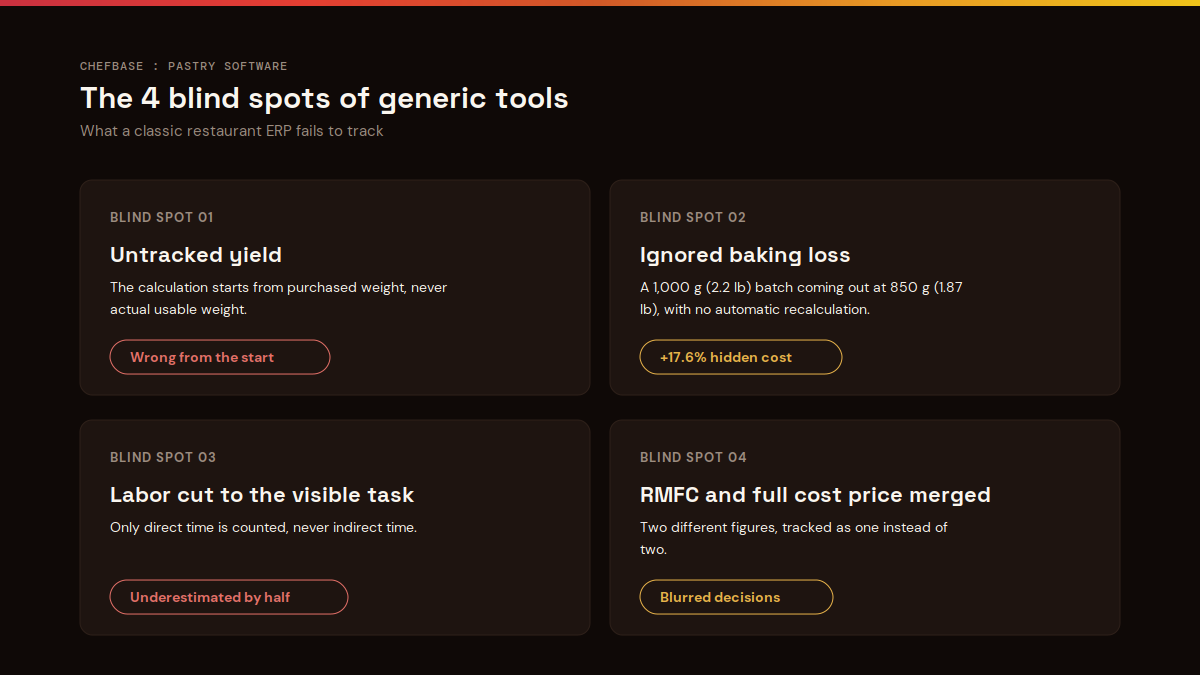
Untracked net yield: the calculation starts from purchased weight, not usable weight, wrong from the start. Ignored baking loss: a 1,000 g (2.2 lb) batch that comes out at 850 g (1.87 lb) concentrates material cost on 15% less mass, with no automatic recalculation. Labor cost cut to the visible task: timing only the direct task underestimates real cost by nearly half. Raw material food cost merged with full cost price: two different figures, treated as one.
Check Sub-Recipe Management, the Point That Changes Everything
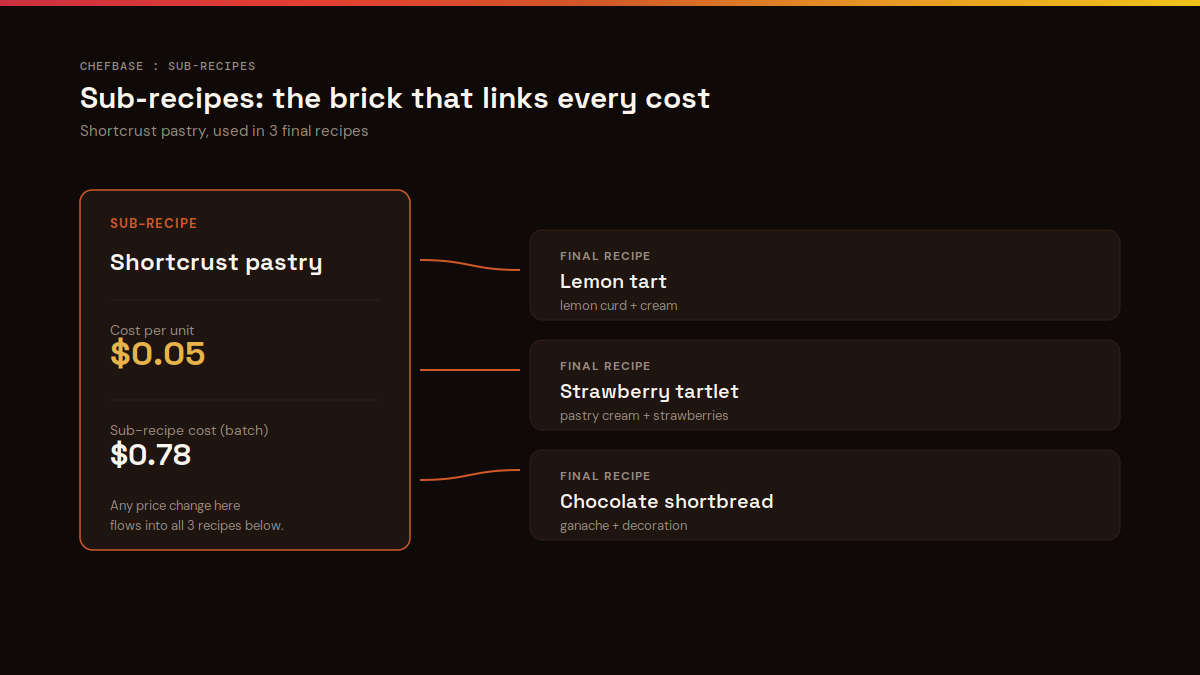
A shortcrust pastry, a cream, an insert: these sub-recipes show up in several final recipes at once. If the tool doesn’t manage them as linked building blocks, every cost (material, labor, energy) has to be re-entered recipe by recipe, and drifts as soon as a price or yield changes. A tool that handles sub-recipes correctly recalculates every affected final recipe automatically the moment a single sub-recipe changes.

Be Wary of Spreadsheets, the False Free Solution
A spreadsheet isn’t free, it costs time and reliability. No built-in traceability for shelf life or allergens. A duplicated sheet on one workstation drifts from the rest of the kitchen after the first manual edit. Material cost is never recalculated automatically when a yield or a baking step changes.
Identify What Pastry-Built Software Does That Others Don’t
A tool built for the trade calculates net yield per ingredient, separates raw material food cost from full cost price, and integrates molecular formulation (texturizers, yield coefficients). It natively handles nutrition and allergen compliance. Some go further with production forecasting or an AI copilot trained on the craft, answering technical questions directly inside the tool.
Run Any Tool Through the 30-Second Test
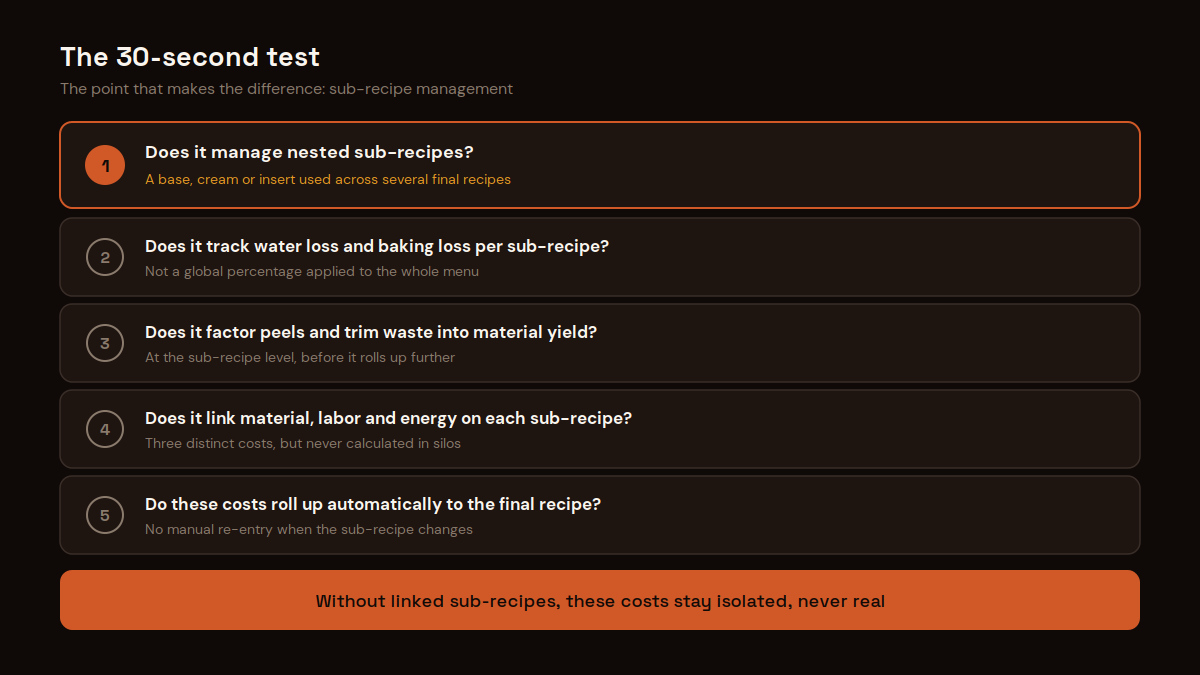
Five questions to ask before choosing: does it manage nested sub-recipes (a base, cream or insert used across several final recipes)? Does it track water loss and baking loss per sub-recipe, not as a global percentage? Does it factor peels and trim waste into material yield at that same level? Does it link material, labor and energy on each sub-recipe instead of calculating them in silos? Do these costs roll up automatically to the final recipe without manual re-entry? Without properly linked sub-recipes, these costs stay isolated, never real.
Measure the Real Cost of Sticking With a Poorly Fitted Tool
An untracked margin gap is money lost every week, as shown by the gap between theoretical and real margin. A correct full cost price calculation is worthless if the tool producing it isn’t built to catch these losses at the source, as covered in our pastry food cost guide.
Decide which kind of tool you are actually buying
“Pastry management software” covers three different products. A point-of-sale system is built to take payments and track sales. General restaurant recipe software is built around dishes, stock and ordering. Pastry-specific software is built around formulation, sub-recipes, cost price and labelling. Many kitchens run a POS alongside a recipe tool, so the real question is which job you need solved first, and how the two will exchange data.
Use this pastry management software buyer’s checklist
Tick each line only after seeing it work on screen, not after reading it in a brochure.
Recipes and costing
- Sub-recipes nested several levels deep, with cost rolling up automatically
- Yield and baking loss per step, not one global percentage
- Full cost price: ingredients, labour and packaging, plus target margin
- Batch scaling by total weight or number of pieces
Compliance and labels
- Allergens and “may contain” statements inherited from sub-recipes
- The allergen list for your market: 14 in the EU and UK, 9 major allergens in the US since sesame was added in 2023
- Nutrition calculated from a recognised reference database, with the option to use supplier data
- Label output suited to your sales channel, for example full ingredient lists for prepacked for direct sale food in the UK
Team and kitchen
- Readable recipe cards on a phone or tablet at the bench
- Roles and edit rights, with a change history
- Multi-site access if you produce in more than one place
Data
- Import from your current spreadsheets or documents
- Full export in a usable format, not just PDFs
Bring your own recipe to the demo
A vendor’s demo recipe is always the one their tool handles best. Send your most complex product a few days ahead, typically an entremet with three or four sub-recipes, and ask to see it built live. Then ask:
- If I change the price of butter, which finished products update, and how fast?
- If I add hazelnut to the praline, does the allergen reach the finished cake on its own?
- Where does the nutrition data come from, and can I override it?
- How do I import fifty recipes from Excel, and who does the work?
- What does a cook see on a phone when scaling this recipe to 3 kg?
Check data ownership and the exit door
Your recipes are your know-how. Before signing, get written answers on four points: the export format (a spreadsheet or CSV with recipes, quantities, sub-recipes and prices), how long your data stays available after cancellation, where the data is hosted and which privacy rules apply, and the notice period and commitment length. A vendor who is vague on exit terms is telling you something. During the trial, run a test export and open the file yourself: if you cannot rebuild a recipe from it, the export does not really protect you.
Calculate the first-year cost
Add up four lines over twelve months: the subscription at your real number of users or sites, any set-up or import fees, your team’s hours for data entry and training, and subtract the hours saved each month on recipe card updates, valued at your loaded hourly rate. If set-up takes 15 hours and the tool saves 5 hours a month, the time invested is recovered in three months. Ask whether prices are per user, per site or per recipe, and model next year too: a plan that is cheap at 2 users can change shape at 6, or when you open a second production site.
Score, trial and decide
Weight each checklist group before any demo (for example costing 35, compliance 30, team 20, data 15), score each tool from 0 to 3 per group and compare totals. Shortlist two tools, then run a two-week trial on five real recipes: a simple product, an entremet, a viennoiserie, a multi-allergen item and a best seller. ChefBase offers a free plan with no card required, so it can be tested under the same protocol as any other option. Treat any tool that cannot rebuild your complex recipe correctly as a red flag, whatever its score elsewhere.
Key takeaway
Generic restaurant software ignores variable yield, baking loss and real labor cost in pastry. The decisive point: sub-recipe management, which links material, labor and energy on every shared base and recalculates them automatically across all final recipes. Pastry-built software also separates raw material food cost from full cost price, and natively integrates nutrition and allergens. Test any tool against these five points before choosing.
The Production feature was built against exactly these five points.
Generic restaurant software wasn’t built for variable yield and sub-recipes. ChefBase was. Start free, no card required.
Frequently asked questions
What is pastry management software?
It is software built to manage a pastry kitchen’s recipes and their consequences: nested sub-recipes, yields and baking losses, cost price and margins, allergens, nutrition and labels. It differs from a point-of-sale system, which handles payments and sales, and from general restaurant software built around plated dishes.
What should I look for in pastry management software?
Check nested sub-recipes with automatic cost roll-up, yield and baking loss per step, full cost price, inherited allergens and trace statements, nutrition from a reference database, labels for your market, mobile access at the bench, edit rights by role, and a full data export.
What questions should I ask in a bakery software demo?
Ask the vendor to build your most complex recipe live, then show what happens when an ingredient price changes, whether a new allergen reaches the finished product automatically, where nutrition data comes from, how spreadsheet import works and how you would export everything if you left.
How much does pastry management software cost?
Pricing varies by number of users, sites or recipes, so check each vendor’s published plans. Compare the first-year cost instead: subscription, set-up fees, hours spent on data entry and training, minus hours saved each month on updating recipe cards, valued at your loaded hourly rate.
Do I need pastry-specific software or general restaurant software?
If your products rely on nested sub-recipes, variable yields and baking losses, test pastry-specific tools first. General restaurant software can be enough when pastry is a small part of a savoury menu. Building one complete entremet in each tool during the demo usually settles it.
Which allergens must pastry software track in the US and UK?
In the UK and EU, the regulated list has 14 allergens. In the US, there are 9 major food allergens since sesame was added in 2023. The software should also carry supplier trace statements separately. Check current labelling rules for your channel with your local authority.
How long should a pastry software trial last?
Two weeks is usually enough if you follow a protocol: enter five real recipes, including an entremet with several sub-recipes, then check cost, allergens, final weight and how readable the card is on a phone. ChefBase offers a free plan with no card required.
How do I avoid getting locked into recipe software?
Before signing, confirm in writing that you can export recipes, quantities, sub-recipes and prices in a spreadsheet or CSV format, how long data stays available after cancellation, and the notice period. Run a test export during the trial to see the actual file.