Ask a pastry chef how long a recipe card update takes, and the answer is usually “ten minutes, maybe.” Count every micro-task involved and the real number is often double. Across 50 recipe cards updated monthly, that gap adds up to hours lost every week.

The Hidden Time Behind Every Recipe Card
A recipe card is never updated in one motion. Every ingredient price change triggers a chain of invisible tasks: finding the right file, recalculating cost, checking the sell price still makes sense, reformatting the document. Each step looks minor on its own. Stacked over a month, they add up fast.
A kitchen running 50 active recipe cards with a monthly ingredient price review can easily lose several hours a month to work that never gets counted as “work.”
Spreadsheets and Paper: Where the Time Actually Goes
A spreadsheet feels like control. In practice, it’s usually where time disappears:
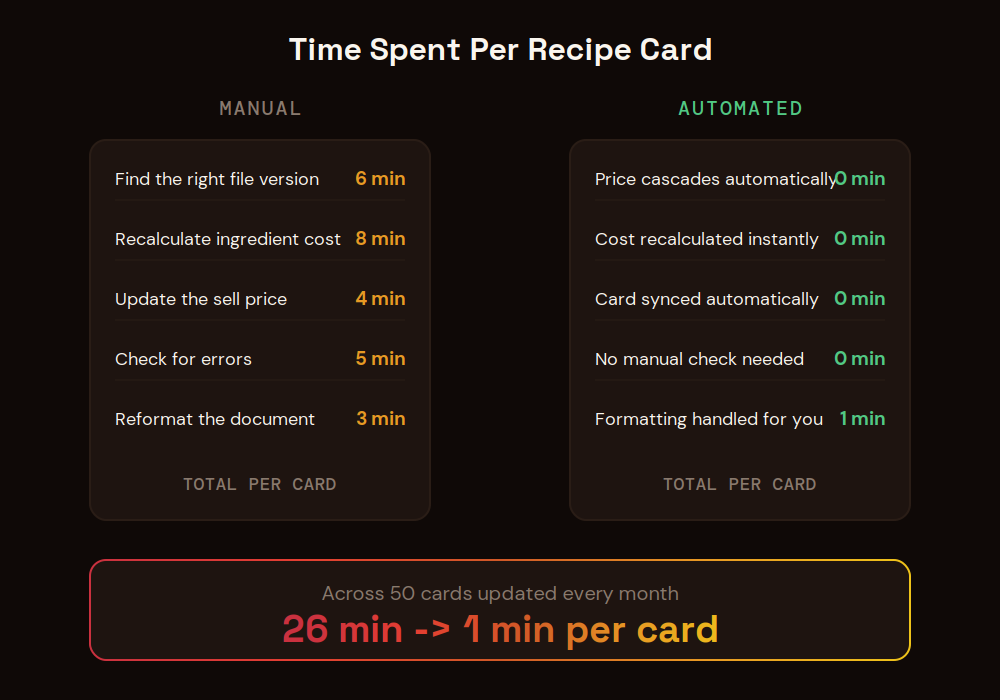
- Finding the correct file version (multiple copies often float around the kitchen)
- Manually recalculating ingredient cost after a price increase
- Updating the sell price without real certainty on margin
- Checking for formula or copy-paste errors
- Reformatting before printing or sharing
Each step alone takes 3 to 8 minutes. Multiply that across your recipe count and update frequency, and the weekly total passes an hour with zero value actually added.
For a deeper look at real cost calculation, see our guide on pastry food cost.
Count the Hidden Cost of an Outdated Recipe Card
An unupdated recipe card isn’t neutral. After every ingredient price increase, check three things:
- Real margin, quietly eroding with no alert triggered
- Sell price, frozen while the underlying cost climbed
- Ingredient orders, calculated against a cost that no longer exists
An outdated recipe card rarely costs much at the moment it goes stale. It costs a lot once it compounds across months and recipes, unnoticed until the numbers are reviewed.
Calculate Your Own Time ROI
Three questions are enough to estimate the time you’re really losing each month:
- How many recipe cards do you actively manage?
- How often do your ingredient prices change?
- How many minutes does a full update take, verification included?
The formula is simple: number of recipe cards multiplied by update frequency multiplied by average time per card. With 50 cards, a monthly price review, and 20 minutes per card, that’s roughly 16 hours a month spent on pure admin work.
What Automation Actually Changes
When one ingredient’s price changes, every recipe card using it should update automatically, no re-entry, no manual recalculation, no risk of missing one. That’s the principle behind how ChefBase handles recipe card management: change one price, and it cascades across every linked recipe.
The time recovered isn’t a few saved minutes. It’s hours given back every month, to production, to creative work, or simply to rest.

To compare your options, our guide on pastry management software covers what generic tools miss on exactly this point.
Key Takeaway
Time lost on recipe card management rarely shows up day to day, but it adds up to hours every month. Calculating your own time ROI is the first step to putting a real number on that hidden cost, and deciding if automation is worth testing.
Frequently asked questions
How long does it take to update a pastry recipe card?
Between 15 and 26 minutes per card with manual management, including finding the file, recalculating cost, and final verification.
Why do spreadsheet recipe cards get more time-consuming over time?
Card volume grows, file versions multiply, and every ingredient price change requires a manual update repeated across each affected file.
What’s the real cost of an outdated recipe card?
It distorts real margin, keeps a sell price out of sync with current cost, and can lead to ingredient orders calculated on the wrong numbers.
How do you calculate ROI for recipe card management software?
Multiply active recipe card count by price update frequency, then by average time per card. Compare that total to the residual time with automated software.
How much time does recipe card software save per week?
For a kitchen with 50 active cards, automation can bring a monthly total of 15 to 16 hours down to under an hour, depending on price change frequency.